


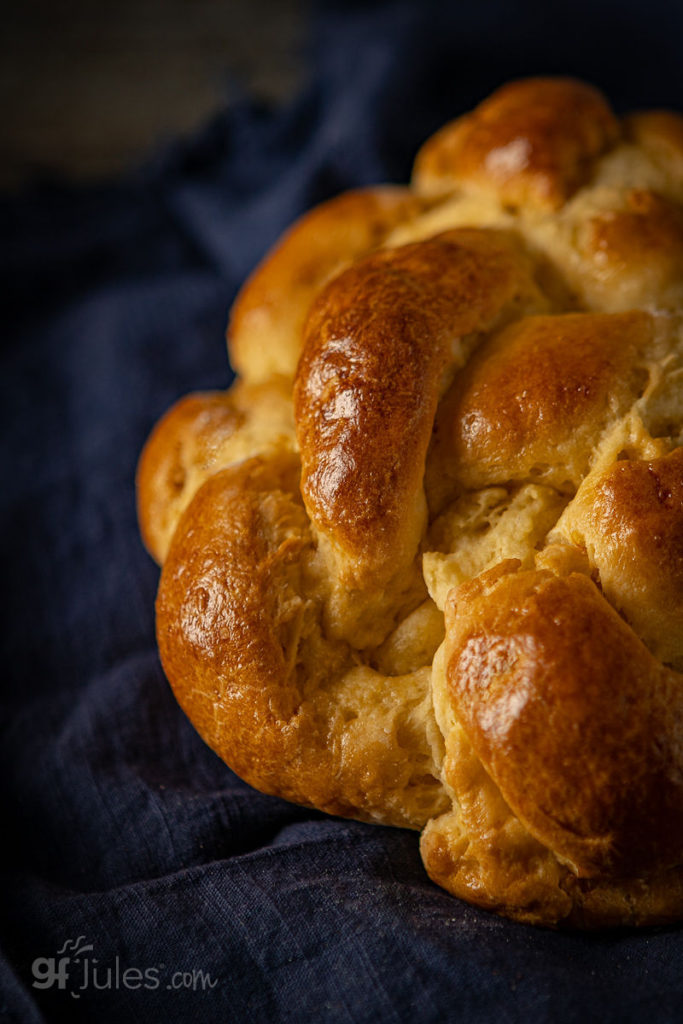
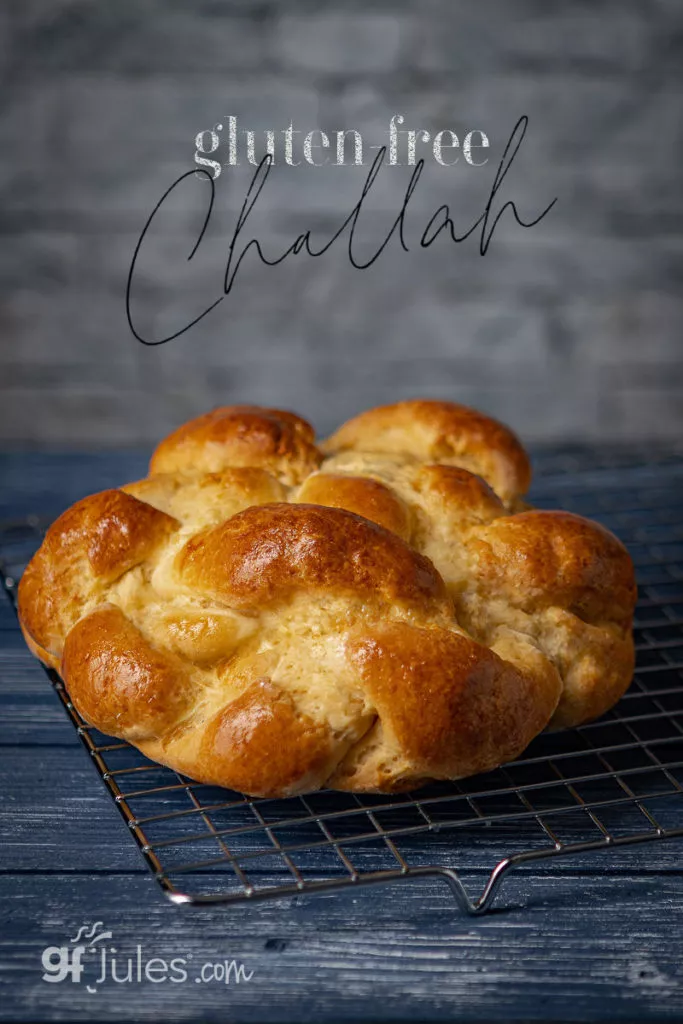
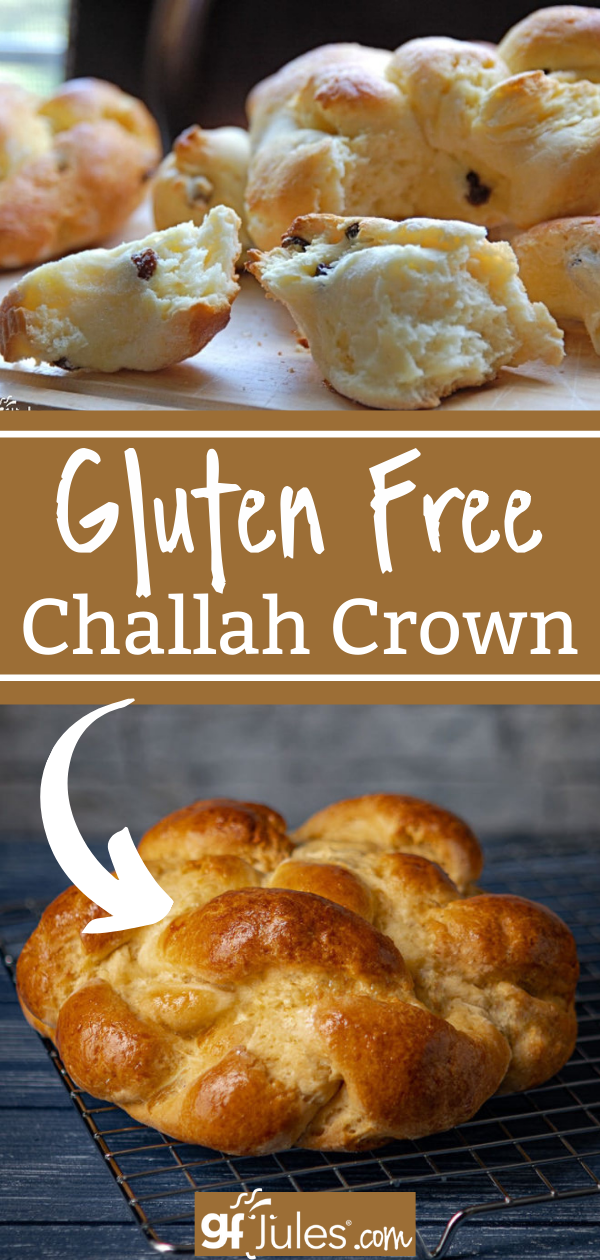
This gluten free Challah Crown is a true showstopper — beautifully golden, soft, moist, slightly sweet, and, yes, you can actually braid this gluten free bread dough! It makes an especially beautiful gluten free challah for Rosh Hashanah, when round challah symbolizes the cycle of the year and the hope for a sweet new year.
And the best part? This gluten free challah is much easier to make than you might think.
The secret is choosing the right gluten free flour for challah. A dry, gritty, rice-heavy flour simply won’t give you dough that’s easy to shape and braid. My award-winning gfJules Gluten Free All Purpose Flour is exceptionally fine and light, while also giving gluten free dough the stretch and flexibility it needs to be shaped into beautiful braided strands.
Yes, you read that right: YOU CAN BRAID THIS GLUTEN FREE CHALLAH!
It’s all about the gluten free flour.
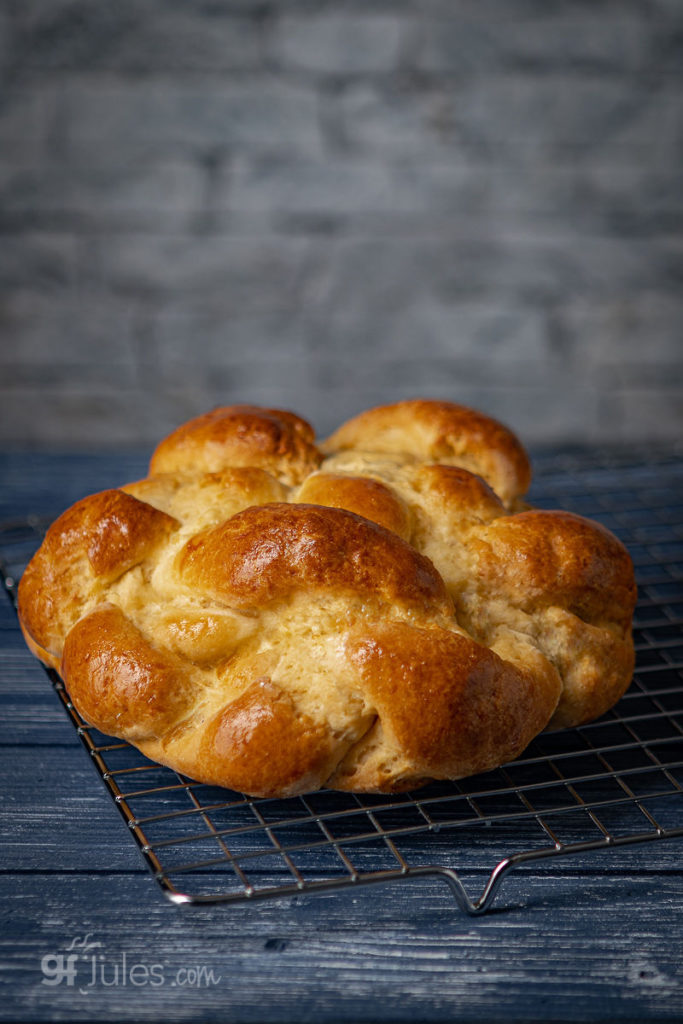
The Secret to Soft, Braided Gluten Free Challah
Traditional challah is made with wheat flour, which naturally provides the gluten network that makes yeast dough stretchy and easy to braid. Gluten free dough needs a little help.
That’s why the flour you choose makes such a dramatic difference.
gfJules Gluten Free All Purpose Flour is designed to behave more like traditional wheat flour in yeast breads. Its fine texture eliminates the gritty mouthfeel associated with many rice-based gluten free flours, while its unique formulation helps create dough that’s soft, flexible and workable.
That means you can make a gluten free braided challah, shape individual strands, and form them into the gorgeous round challah crown traditionally enjoyed at Rosh Hashanah.
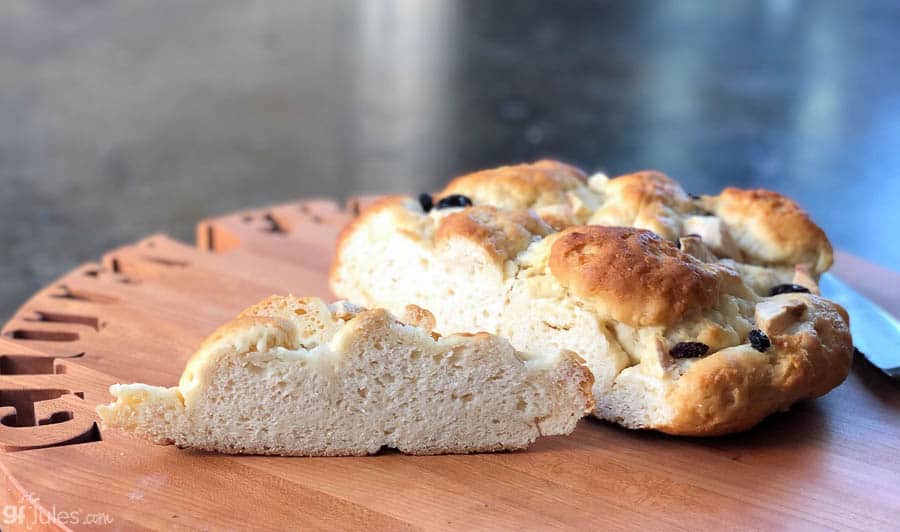
What Is Challah and Why Is It Served at Rosh Hashanah?
Challah is a traditional Jewish bread enjoyed on Shabbat and holidays, including Rosh Hashanah, Yom Kippur and Hanukkah. While challah is deeply connected to Jewish traditions and celebrations, its soft texture and lightly sweet flavor make it a wonderful bread to serve for special meals throughout the year.
At Rosh Hashanah, the Jewish New Year, challah takes on additional symbolism.
Instead of the elongated braided loaves often associated with Shabbat, challah is traditionally shaped into a round challah at Rosh Hashanah. The circular shape can represent the cycle of the year and the continuity of life, with no beginning or end.
Rosh Hashanah challah is also traditionally sweeter, representing the hope for a sweet new year. This gluten free challah recipe can be made with raisins for even more sweetness, and there’s nothing better than tearing off a piece of warm challah and dipping it into good-quality honey.
Why You’ll Love This Gluten Free Challah Recipe
If you’ve been searching for a gluten free challah recipe that can actually be braided, this is the one to try.
- Soft and moist, not dry or gritty
- Easy to shape and braid using gfJules Flour
- Perfect for making a gluten free challah crown
- Beautiful centerpiece for Rosh Hashanah
- Delicious enough to serve to gluten eaters, too
- Can be made with raisins for traditional holiday sweetness
- Works beautifully as a homemade gluten free Jewish bread
- Much quicker and easier than many traditional yeast breads
I had friends over recently and served these beautiful round challah loaves because they’re one of my family’s favorite breads — and it happened to be right before Rosh Hashanah.
My friends had made their own traditional gluten-containing challah the week before, and they weren’t particularly thrilled with the results. When they tasted my gluten free challah, they were blown away.
That’s one of my favorite things about gluten free baking: homemade gluten free bread can absolutely be as good as — and sometimes even better than — its gluten-containing counterpart.
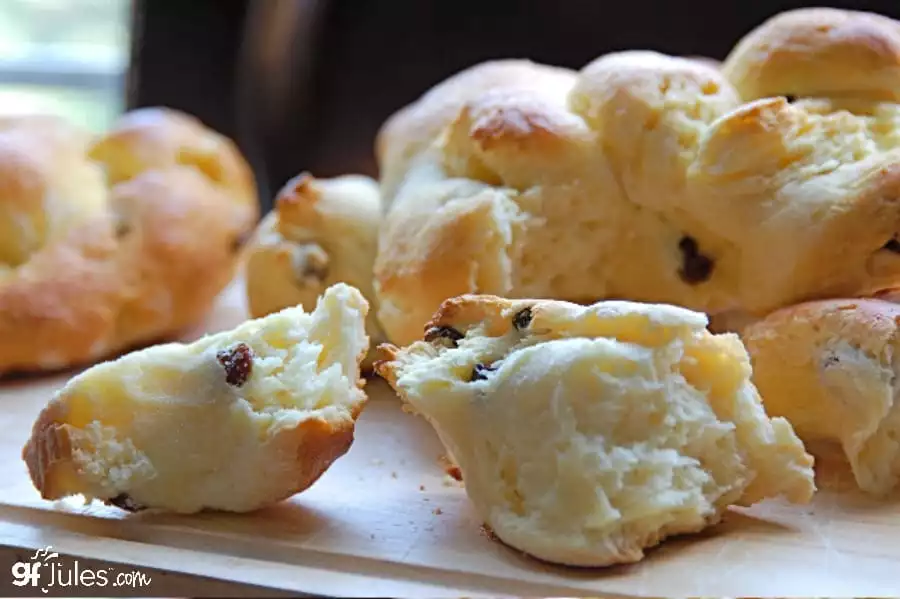
How to Braid Gluten Free Challah Dough
If you’ve ever tried to braid gluten free bread dough, you may already know the problem: many gluten free doughs are either too sticky, too crumbly or too fragile to form into strands.
This recipe is different.
The dough will initially be thick and sticky, but once it’s lightly dusted with gfJules Flour, you can shape it into long strands that are flexible enough to braid.
That’s the magic of using a gluten free flour blend that has been formulated for yeast baking.
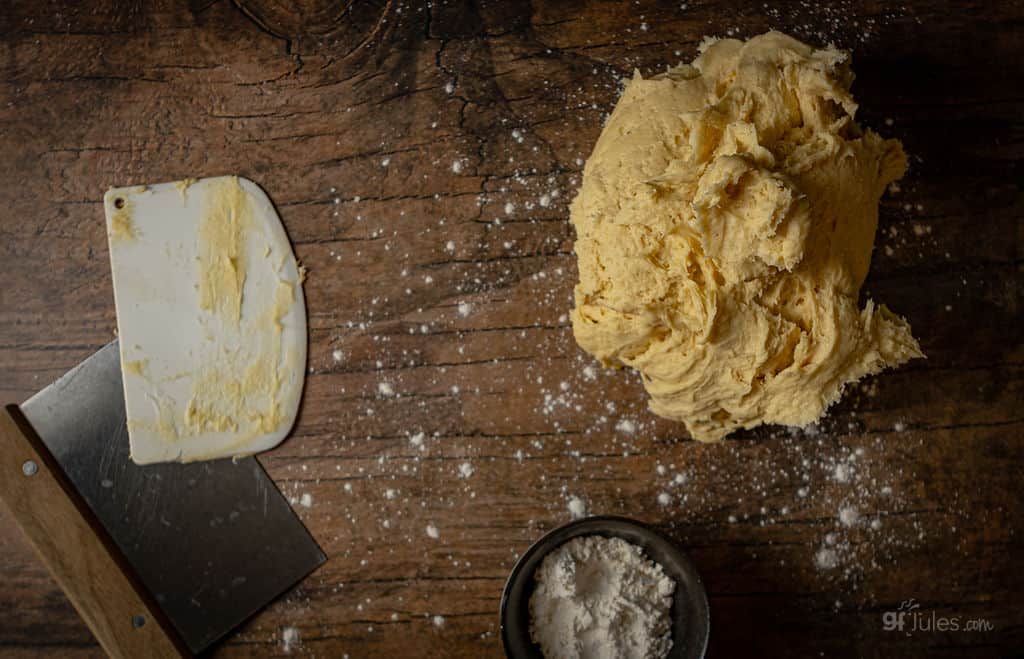
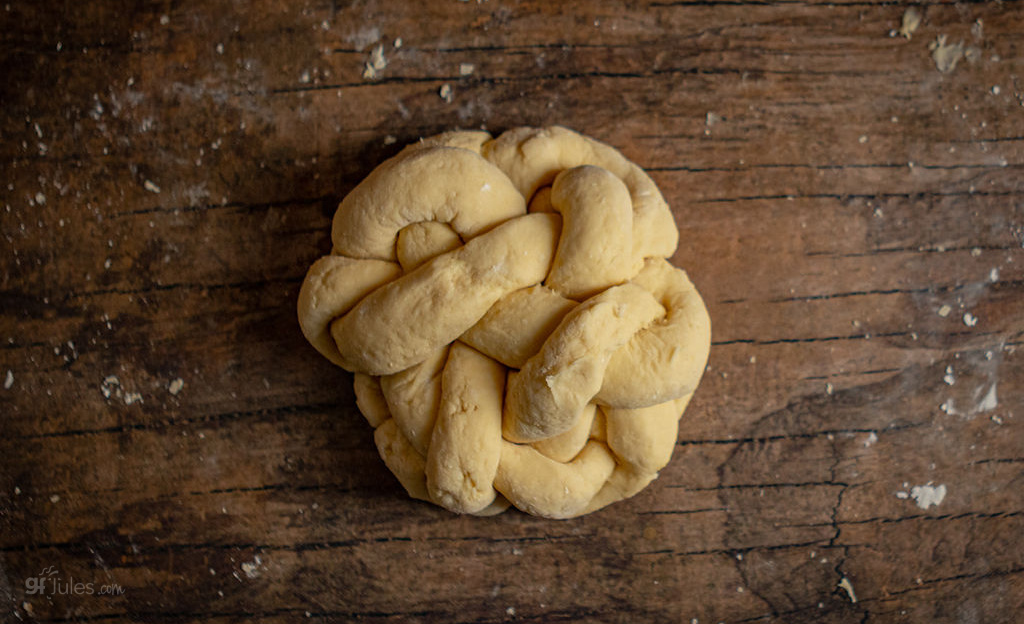
Once the strands are formed, follow the shaping instructions in the recipe to create the beautiful braided crown.
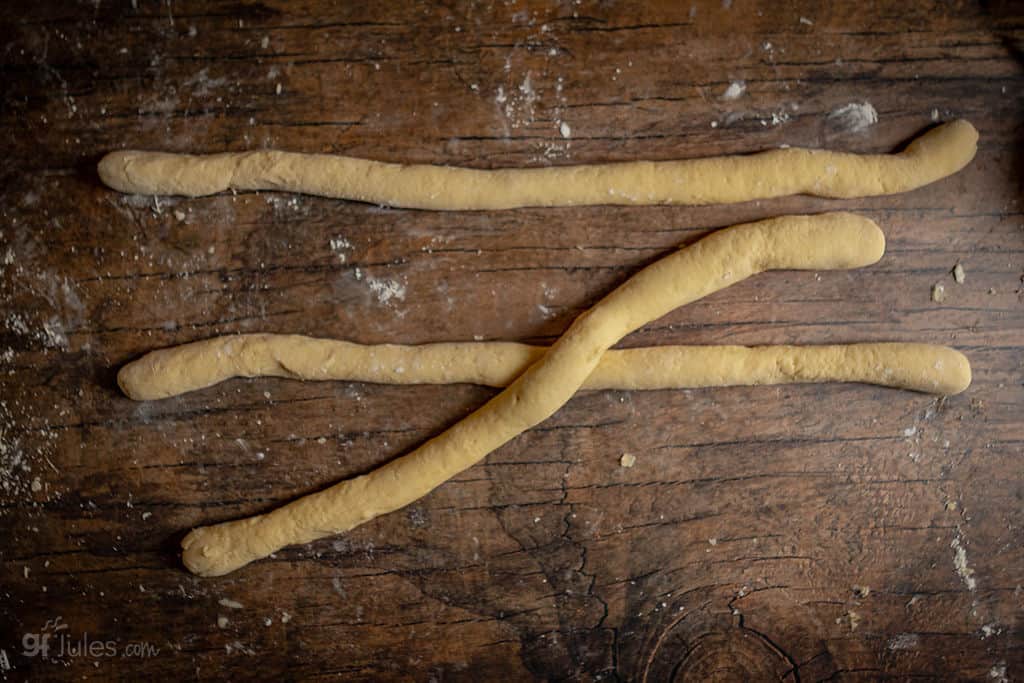
That final twist into a round challah crown is what makes this loaf such a spectacular centerpiece.
How to Get a Golden, Soft Gluten Free Challah
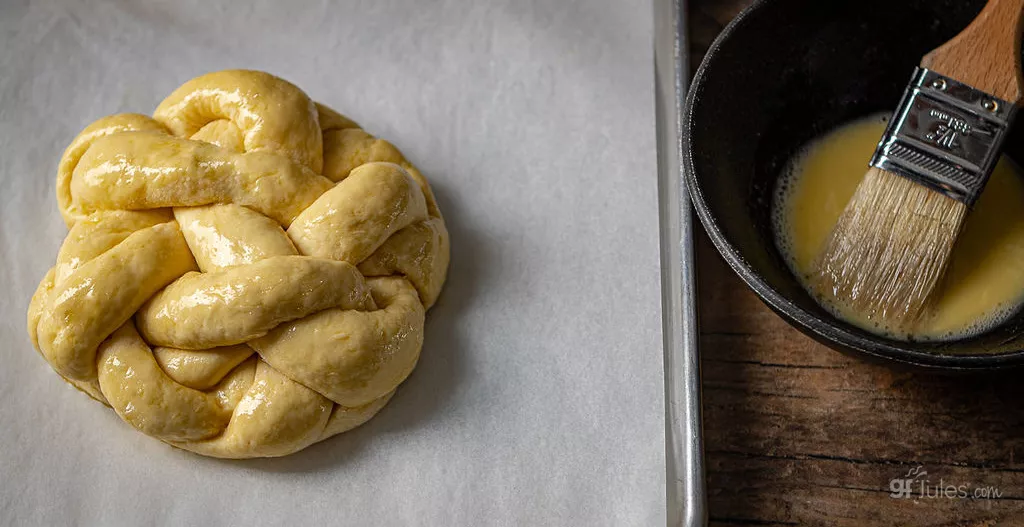
Before baking, brush the shaped challah with egg wash. This helps give the loaf its beautiful deep golden-brown crust while helping the finished bread stay soft and moist.
And once it’s baked?
Well, that’s when the real challenge begins: trying not to eat it immediately!
Gluten Free Challah for Rosh Hashanah: Honey, Raisins and a Sweet New Year
For Rosh Hashanah, challah is traditionally made sweeter to symbolize the wish for a sweet new year.
I love adding raisins to this gluten free challah, then serving it with honey for an extra-special holiday tradition. The combination of soft, slightly sweet bread, chewy raisins and golden honey makes this gluten free Rosh Hashanah challah especially memorable.
Whether you’re making challah for a Jewish holiday, accommodating someone with celiac disease, or simply looking for a beautiful homemade gluten free bread, this recipe gives everyone at the table something to celebrate.
Can Gluten Free Challah Be Used for Hamotzi?
If you are specifically looking for a gluten free challah that qualifies for Hamotzi, there is an important distinction to understand.
Traditional Jewish law identifies five species of grain associated with Hamotzi: wheat, barley, rye, spelt and oats. Of these, oats are the only naturally gluten free grain.
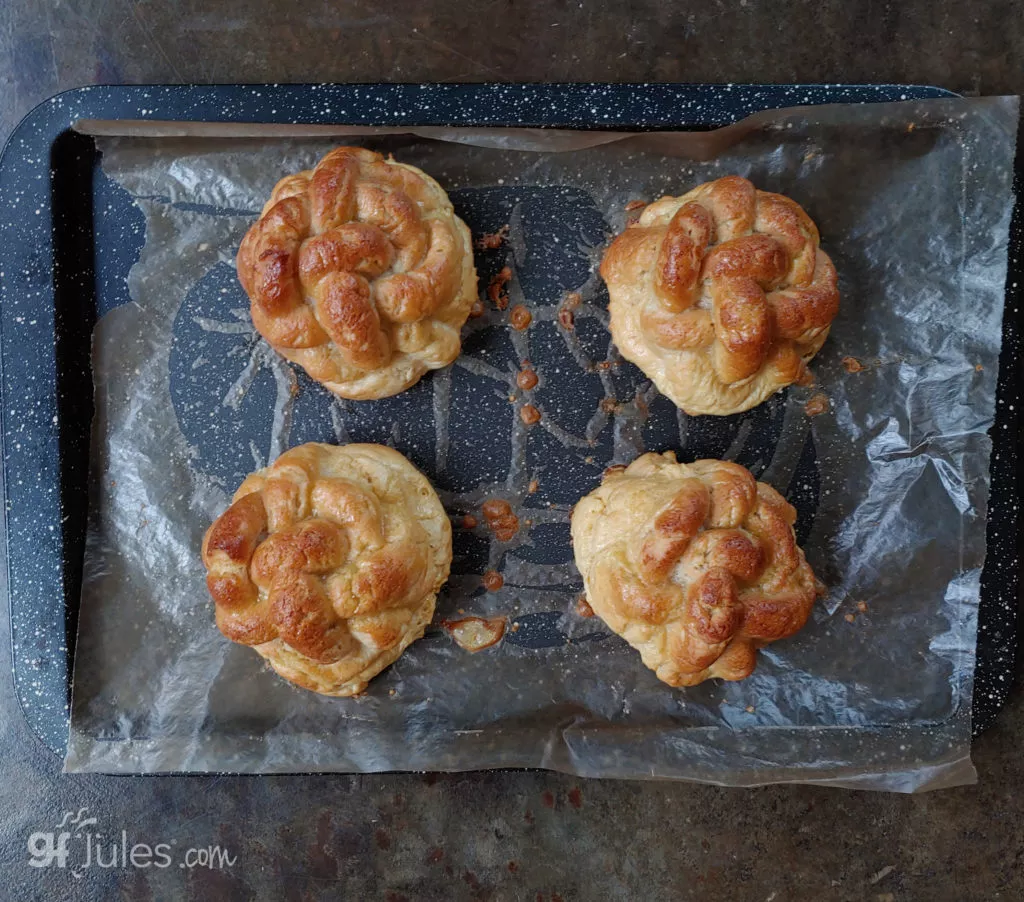
If you are making a challah containing 51% oat flour for this purpose, I recommend using a molded challah pan rather than attempting to braid the dough. The dough is more difficult to braid when a significant portion of the flour is oat flour rather than gfJules Flour.
That said, readers have told me they’ve successfully braided this dough using as little as 49% gfJules Flour. It simply isn’t quite as easy to work with.
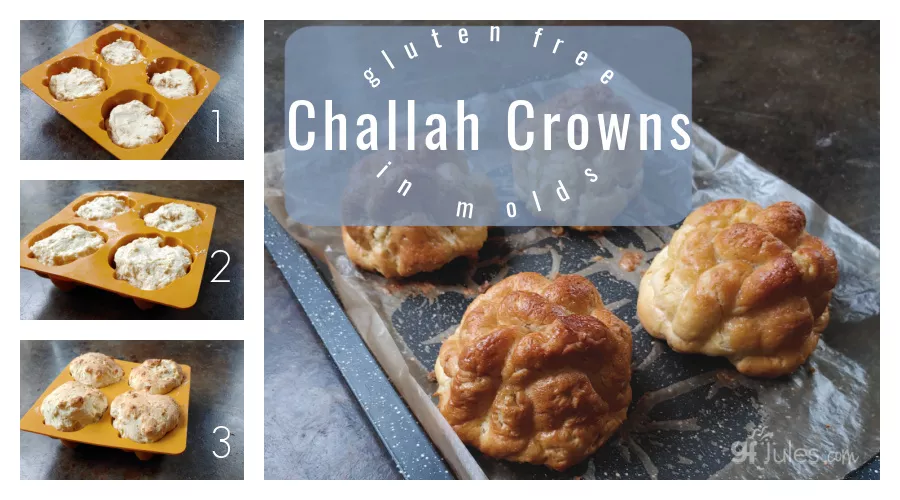
2) rise in pan
3) bake 15 minutes in pan then turn out to bake 5 minutes on baking sheet
Baking gluten free challah crowns in molded pans: fill the mold 1/2 to 2/3 full, allow the dough to rise in the pan, then bake before turning the challah out onto a baking sheet to finish baking.
If you use a molded challah pan, you may have more dough than the pan can hold. Simply put the extra dough into a loaf pan or muffin pan and make additional gluten free rolls.
Making Gluten Free Oat Flour
When I use oat flour, I prefer to make my own gluten free oat flour. It’s incredibly easy, and starting with whole purity protocol gluten free oats makes it easier to know exactly which oats you’re using.
Learn how to make your own gluten free oat flour.
You can also find purity protocol gluten free oats in my gfJules shop.
Want a Traditional Braided Gluten Free Challah Loaf?
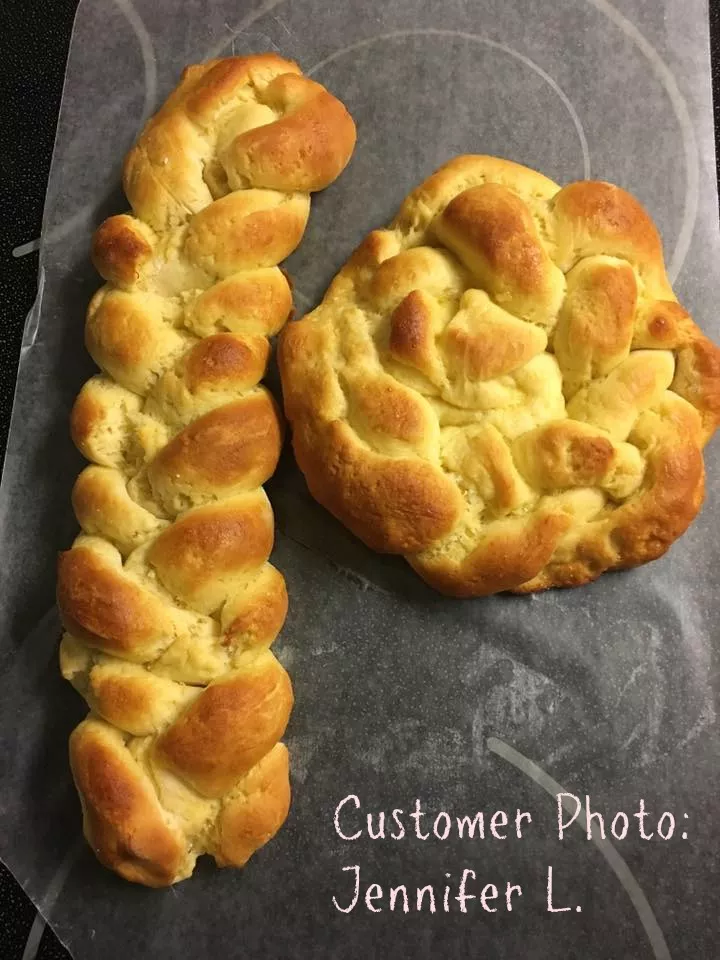
This recipe makes a beautiful round gluten free challah crown, but if you’d prefer the classic elongated braided shape, I’ve got you covered.
Try my Gluten Free Challah with Apples and Raisins for a gorgeous braided loaf with the same soft, tender texture.
The Secret to Easy Homemade Gluten Free Bread
Everyone who has watched me teach gluten free bread baking in cooking classes or demonstrations knows my favorite gluten free baking secret.
Shhh… don’t tell the gluten-eaters!
Homemade gluten free bread can be surprisingly easy — and often much faster than making traditional yeast bread.
Once you have the right gluten free flour, there’s no reason to settle for dry, crumbly or gritty bread. This challah is proof.
So whether you’re celebrating Rosh Hashanah, preparing a gluten free Shabbat meal, observing another Jewish holiday, or simply craving a beautiful loaf of homemade gluten free bread, this gluten free challah recipe is ready whenever you are.
It’s soft. It’s golden. It’s beautiful.
And most importantly, it’s gluten free bread you can actually braid.
Celebrate a sweeter day with this gorgeous gluten free challah crown!
Gluten Free Challah Crown Recipe
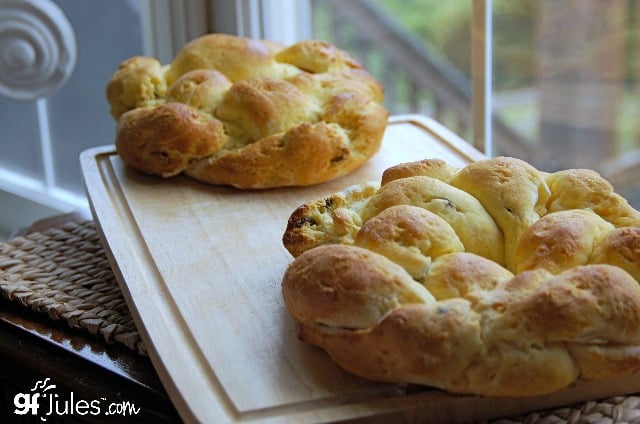
Gluten Free Challah Crown
Ingredients
Gluten Free Challah Bread Ingredients
- 1/2 cup + 2 Tbs. warm water
- 1 Tbs. gluten free yeast like Red Star -- not platinum! -- or Fleishmann's
- 1 tsp. granulated cane sugar
- 1 cup vanilla dairy or non-dairy yogurt at room temperature (So Delicious® Vanilla Coconut Yogurt)*
- 2 tsp. apple cider vinegar
- 5 large egg yolks at room temperature slightly mixed**
- 1/3 cup sunflower oil OR non-GMO canola oil OR extra virgin olive oil
- 4 Tbs. honey OR agave nectar OR maple syrup
- 4 cups (540 grams) gfJules™ All Purpose Flour
- 1 Tbs. psyllium husk powder (added for smoother texture, but if not using, reduce total water by 2 Tbs.)
- 3 Tbs. + 2 tsp. granulated cane sugar
- 1 1/4 tsp. kosher salt
Toppings
- 1 large egg mixed
- poppy seeds sesame seeds, raisins, diced apples or other toppings or mix-ins (optional)
Instructions
- Preheat your oven to 200º F, then turn it off; if you have a warming drawer, you may set that to low/moist setting instead. Prepare a baking sheet by lining it with parchment paper.
- In a small bowl, mix together ~1/3 cup (5 Tbs) warm water, yeast and 1 teaspoon of sugar to prove the yeast; set aside.
- In the bowl of your stand mixer, add the remaining wet ingredients (remaining 5 Tbs water, yogurt, cider vinegar, egg yolks, oil, honey) and mix until combined.
- Whisk together the dry ingredients in a separate bowl (gfJules Flour; psyllium, 3Tbs + 2 tsp. sugar; salt).
- After 5 minutes of proofing, stir in the bubbling yeast-water mixture into the wet ingredients (note: if your yeast isn’t bubbling at this point, throw it out and start again with fresh yeast).
- Gradually stir the dry ingredients into the wet until fully integrated, adding more warm water by the tablespoon only as needed to get the dough soft and so that the dough is not tight or stiff — you should be able to pull the dough gently without it feeling tight or like it would bounce back — if it’s stiff, add more warm water then mix 1-2 minutes more on medium speed to integrate the additional water. The dough should be workable; keep in mind you will be braiding it, so it can't be too loose or too tight (think of Goldilocks dough!)
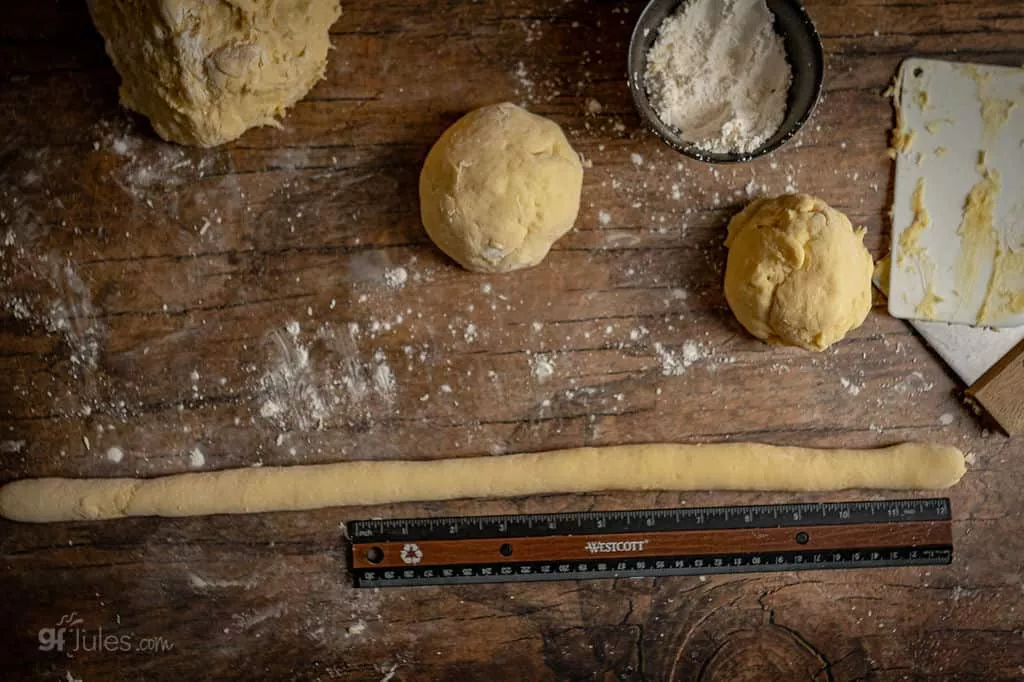
- Once the dough is combined, divide it in half and divide each half into three equal-sized balls. The dough will be sticky, so use extra gfJules Flour on your hands and rolling surface (I like using a bench scraper like this one to help me cut and roll the sticky dough).
- Roll each ball out into an 18-inch coil or log on a clean, flat surface dusted lightly with gfJules Flour. If you have trouble rolling because you've used too much flour, dab a bit of water onto the counter or mat.
- Pinch together one end of each coil, wetting them slightly with water to help them join together at the top, then braid them, finishing by connecting them to the top of the other end in order to form a crown, or circular shape, or simply leave as a long braid.
- Gently transfer to the parchment-lined baking sheet. Repeat for the second set of three balls. In the alternative, you can simply divide the dough in half, roll out into a flattened coil, then twist the coil upon itself and join at the ends to form a circular loaf; repeat with the other half of the dough ball.
- In a small bowl, mix the extra egg (at room temperature) together and brush over each loaf, coating the entire surface. Sprinkle the seeds or any toppings at this point, then place the tray (covering the loaves with wax paper sprayed with cooking oil) in a warming drawer set to low heat, or into a warm location for 20 – 30 minutes. (Don’t expect the bread to rise much at this stage).
- Once risen slightly, place the uncovered tray in an oven preheated to 350º F (static) or 325º F (convection) for 20 minutes or until a toothpick inserted into the center of the bread comes out dry, or with some crumbs attached but no wet dough.
- Remove to cool on a wire rack.
Video
Notes
** Please keep in mind that nutrition information provided is per serving, which may vary. While we have taken care to provide you with the most accurate nutritional values possible, please note that this information may differ significantly depending on the exact ingredients and brands that you choose to use to make this recipe. Additionally, where options are given for ingredients, the resulting calculation may include all ingredient options instead of only one per line, skewing the totals significantly.
I hope you love this recipe as much as we do!
Pin it for later!













I tried the Challah – I don’t think it will work with any flour except Jules. I used Arrowhead, it was a mess, not even bird eadible…an expensive mistake. A disclaimer that the recipes will work only with your bread would have been helpful!
Hi Melinda, yes, all gluten-free flour blends are quite different. I’ve never worked with Arrowhead before; I only write recipes for my flour because I know it works and I don’t have time to waste messing around with other blends that require adjustments. There is a link on the page of my blog that says, “What’s So Special About Jules’ Flour, Anyway?” it takes you to a page that describes all about my flour and why it works so well in most wheat flour recipes, and doesn’t have a gluten-free taste or texture we have all come to recognize (and dislike!). Many other GF flour blends have different proportions of starches and whole grains and they behave quite differently. I hope you get to try this recipe sometime with my flour – it’s an amazing recipe, and one of our fan favorites! Happy Holidays!
Just made this bread recipe, but didn’t realize Jule’s flour is the writer’s flour! Lol. I went to the store looking for Jule’s flour, couldn’t find it and so bought Bob’s Red Mill gluten free flour. This was my first experience with gluten-free and I didn’t realize I would need to add xanthum gum until too late! My bread was already braided. I guess I’ll have to try again after ordering Jule’s flour. The Bob’s Red Mill is kind of yellowish in color, is made from beans, and smells a little strange (beanie).
Hi Jody, I’m not surprised about your experience with Bob’s flour — bean flour has an odor and a taste that can be off-putting to some folks. I stay away from it, myself. I think you’ll have a more pleasant gluten-free experience if you get to work with my flour next time (and the xanthan gum is already included!).
I am very interested in making a gluten-free challah. Where do I purchase gfJules All Purpose Flour?
Hi Julie – just click on the “products” tab at the top of the page and it will take you to our store!
After searching and reading for many hours on GF baking I settled on trying out your flour and cookie mix. Glad I did!
I must tell you that my nephew cried when he bit into the challah I made using your flour mix. He said he never though he would ever eat challah again.
The cookie mix made with raisins and your instant oats was a hit with all the non-GF family members and the microwave lemon squares went flying off the plate.
You really made our New Year celebration special.
Thanks!!
Oh Marcia, that is SO wonderful to hear! I’m so glad you decided to try my products and that your holidays were happy and tasty because of it! Thanks so much for taking the time to let me know!
In the process of making this for The holidays, had to use a gluten free all purpose flour, since The one I ordered from your site has not arrived. It is my first time making this and hope it is a hit with the fam.
Hi Jennifer, I’m sorry that you didn’t have my flour to work with for this recipe. I hope it turned out ok, anyway, but if you were less than happy, please try again when you receive my flour! All GF flours behave differently and this is one of those recipes that really shines with the right blend! Hope you had a great holiday!
Is there a way to use an oat flour or a mixture of oat flour and regular mix.of flour? I don’t want it to come out too heavy. Thanks!
Hi Shoshi, you could probably substitute about 1/2 cup of my Jules Gluten Free All Purpose Flour for oat flour in this recipe without adding too much weight. Let me know how it turns out!
Just received in the mail my Jules GF flour and ready to make Challah for Rosh HaShanah.Can I bake and freeze the loaves? If yes — please send directions for freezing & thawing.
If freezing is not recommended, how many days does the Challah stay fresh? What is the preferred method for storing?
Many Thanks,
Miri
Hi Miri, I’m glad you’re going to use some of my flour for challah. This is such an amazing recipe! In answer to your questions, I have baked and frozen the loaves before, then let them thaw and gently heated them in the oven, wrapped in foil. After baking, I find that my challah stays fresh for about 2-3 days without having to be warmed, but can be warmed thereafter and is still delicious for another couple of days. Truthfully, it rarely stays around in my house for that long – everyone loves it! I store my breads in a zip-top bag on the counter, never in the fridge. Enjoy!
I did it! I made your challah for my nephew, and he loved it (as did everyone else at the table). Flouring my hands and the bread before braiding was definitely key. He’s looking forward to braiding the challah with me this week. Thanks so much! I’m hoping to try to use all the dough to make a 6 braided loaf instead of two smaller ones. How long do you think I should bake it if it’s in one large loaf?
Thanks for letting me know, Sue! That’s wonderful news, that you had success with this recipe and that everyone loved the challah! As for baking as one large loaf, it’s all about cooking in the very middle, so just keep testing. If the outside is getting too done, I’d recommend covering it with foil and continue to bake until the middle is done. Enjoy the recipe and spreading GF yumminess to your family!!!
My 6 year old nephew has been begging me to make him a braided gluten free challah, so I’m trying your recipe and hoping it will make him excited beyond belief. I just ordered your gluten free flour and I’m planning to make challah tomorrow. I can’t seem to find rapid rise yeast. Am I better off using Fleischman’s Rapid Rise yeast or Red Star’s Active Dry yeast?
Oops, I mean to say I can’t seem to find RED STAR’s Rapid Rise yeast.
It’s a delicious recipe, sue, I know your nephew will love it! If you use Fleischman’s Rapid Rise yeast, the directions will be the same; if using active dry yeast (Red Star or Fleischman’s), you’ll just want to let it rise longer before baking. Enjoy!
Thanks Jules! I’ll try it and keep you posted. So you think it will be okay with either brand of Rapid Rise?
Hey!
I tried this 2 weeks ago and it was too gloopy to braid, felt more like a cake batter. Help!!
Also, any ideas about how to reduce the amount of eggs used? Perhaps flax?
Thanks!
jesse
Hi Jesse – did you make any other subs in the recipe, such as reducing eggs, using egg subs or a different flour? Also, what kind of yogurt did you use?
I can’t get your flour in Canada, and really, really want to try this recipe. Any advice or substitutes? Thanks!
Hi was searching for a GF challah to make french toast this weekend and am wondering If I do not have your flour blend would I be able to use another all purpose gf flour blend?? thanks!!!! Or a mix of ingriendents I can do at home. I do have all the ingredients just not modified tapioca. thanks again
Hi Fran – good thinking to ask first! All gluten-free flour blends are different … very different, actually. It’s not like using a different brand of wheat flour. My flour has 5 gluten-free flours and xanthan gum together in a mixture that works well in nearly any type of recipe; other flours may have things like bean flour or lack xanthan gum — they would produce very different results and may fail altogether. If you don’t have my flour, do you have any of my cookbooks that give recipes for making a homemade blend (without modified tapioca starch) with the proper bulk flour: starch ratio for recipes like this? Sounds like you might have the ingredients you need and don’t mind mixing them, so I’d suggest first making your own mix from one of those recipes to use in this bread recipe for the best results.
Thanks!!!! I will try with a GF mix. Can you sell your products anywhere in NJ??? That would be great to be able to just pick up in a supermarket. Thanks again for your help, going to try and see how this comes out
Maybe it has something to do with our elevation, or the humidity… or something. But when I made the bread according to instructions, my dough was the consistency of pancake batter until I added an additional cup of flour. So I added the additional cup, which made the braiding possible… but the taste was slightly floury. How would you compensate for an elevation, or whatever problem that caused my liquids/dry ratio to be wrong?
Hi Amy, this dough should not be like pancake batter, but it is wet and sticky until you roll it in more flour. Elevation could certainly be playing a roll here. Make a note and next time you make the recipe, maybe add 1/2 cup of flour to the dough and then be sure to have extra to roll the dough in to keep it from being sticky. Hopefully that will take care of the over-floured taste, and make it easier to work with, as well!
Hi Jules
I recently made the trek into San Francisco to pick up a bag of your flour and try this recipe (for Vday French Toast). I followed the directions to a tee but my dough came out ridiculously wet…as in way to wet to do anything with it. It was all i could do to scoop it up and throw it into a loaf pan and it predictably came out extremely dense after that. My only guess is that the recipe means 1 “container” (6 oz) of the yogurt instead of 1 “cup”?? I used a full cup which is almost two containers…
Hi John, if you ever have recipe questions, feel free to email customer support at Support@JulesGlutenFree.com to walk through a recipe with you. This dough is very wet, but once rolled in more flour on the rolling surface, it’s easy enough to manage. A bench scraper or even a rubber spatula can help. The recipe calls for 1 cup of yogurt, or 8 oz, which is far less than two 6-oz containers. Perhaps you did add a bit too much yogurt? At any rate, it should not have been too wet to work with or baked up dense (although I applaud you for putting the wet dough in a loaf pan and seeing if you could salvage something!). Please do email support and let’s try to figure out what went wrong, because this is a wonderful recipe and I want you to be able to enjoy it!
My daughter was diagnosed with Celiac just after Thanksgiving and I was so thankful to find your book “The First Year: Celiac Disease and Living Gluten Free” it was and is a life-saver! I felt so much better equipped to handle all of the changes we would have to make and you saved the day with your Challah bread recipe which we enjoyed with our Christmas dinner!
After reading about how one person used this recipe to make Easter bread, I decided to roll out half of my dough and try cinnamon rolls! We just polished them off and no one even gave it a second thought that they weren’t my normal gluten ones! Yum!!!!
Oh Laurie, that is so wonderful to hear! Thank you so much for sharing that with me – you made my day! And the challah as Easter bread sounds amazing! Good thing there’s still time for me to make it before Easter!! If you want to give my cinnamon rolls recipe a try, you can compare and see which version your family prefers! All the best to you and your daughter!
The first time I made this challah I was kind of disappointed. I thought the dough was too sticky to roll and just put it in loaf pans. The taste was WONDERFUL though. This last time though I again thought it was too sticky but I just went for it and threw the dough into some Jules flour on the table and rolled. VOILA! Little strips to braid! I made mine into numerous little loaves about 6 inches long. I kept one out for Shabbat and froze the rest. Today I got one out and after defrosting in the microwave, I could again enjoy unbraiding the loaf bite by delicious bite. I LOVE your flour!!!
Oh Louise, I’m so glad you didn’t give up! Using extra flour to roll the dough is definitely key – so happy you have delicious Challah back in your life now!
HELP! I have (tried to)made this bread 3 times. It is never cooked- always raw inside. I put in in my 200*then turned off oven, for 30min. 15min longer this time with oven at 150*. then, 30 min in 350*oven. I left it in for 20 min longer, tented with foil, and it’s better, not great. Should I be letting it rise in a turned ON oven? I used Bob’s red mill and added xanthum as required. Please advise.
Dee
Hi Dee, why don’t you try it with my flour, as the recipe is written? I can’t vouch for any other flour blend in any of my recipes, particularly one so different as Bob’s Red Mill. The results could not possibly be the same when such a critical ingredient is so totally different. I know you’ll love the recipe when you use the right ingredients! By the way, my flour is on special right now for $5 off and the results are guaranteed!
Tonight we’re off to celebrate Hanukkah with some friends we consider family.
They’re Jewish. We’re Christian.
I made this GF challah last year, and it was such a big hit that our amazing hostess asked me to bring it again this year.
Let love reign!
That’s wonderful, Wendy!!! Delicious food, all can share, can be quite a wonderful way to share love any time of year!
Hi Jules, What can happen if we use regular yeast instead of the rapid rise yeast? That is all I have in the house. Do I change the time it rises? Baking time? Help please.
Hi Anna, if you only have regular yeast, just plan on letting it rise much longer. I would let any bread recipe rise for at least one hour or more before baking with regular yeast. It should work just fine with that extra rise time, though!
Hi Jules, I love your bread mix packets & have several in my pantry now. Could I use the bread mix packet for Challah? What would you add or modify?
Wow, Pam, that’s a really interesting question! The mix makes a totally different kind of bread than traditional challah which is largely egg yolk-based. On the plus side, the bread mix makes a thick dough. I guess if I was going to try the bread mix as challah, I’d substitute 2 egg yolks for each egg called for in the recipe, and if you could get your hands on one of those braided bread pans, you wouldn’t even have to worry about braiding the dough, it would just bake in the pan with a braided impression on top! That’s where I would start, but expect to do some experimenting! At least it’ll taste delicious no matter what, so you can always eat any mistakes! Let me know if you try it – I’d love to know how it turned out!