

Xanthan Gum, Guar Gum and Psyllium: A Gluten Free Baking Guide
“Baking with gums?” you say. “Why bake with GUM!??”
Good question. I’m glad you asked.
If you have ever squinted at a gluten-free recipe wondering what xanthan gum actually is, whether you really need it, or what on earth psyllium husk is doing in your bread when you last saw it in a box of Metamucil, you have come to the right place.
Why Gluten Free Baking Needs Binders
Gluten is what holds baked goods together, and no single gluten-free flour can replicate it on its own. That is why we blend several flours to mimic wheat’s qualities, and why we need something to stand in for gluten’s stickiness. Without it, most gluten-free recipes end up a crumbly mess.
That is where xanthan gum, guar gum, and psyllium husk come in.
Xanthan Gum (zan-than)
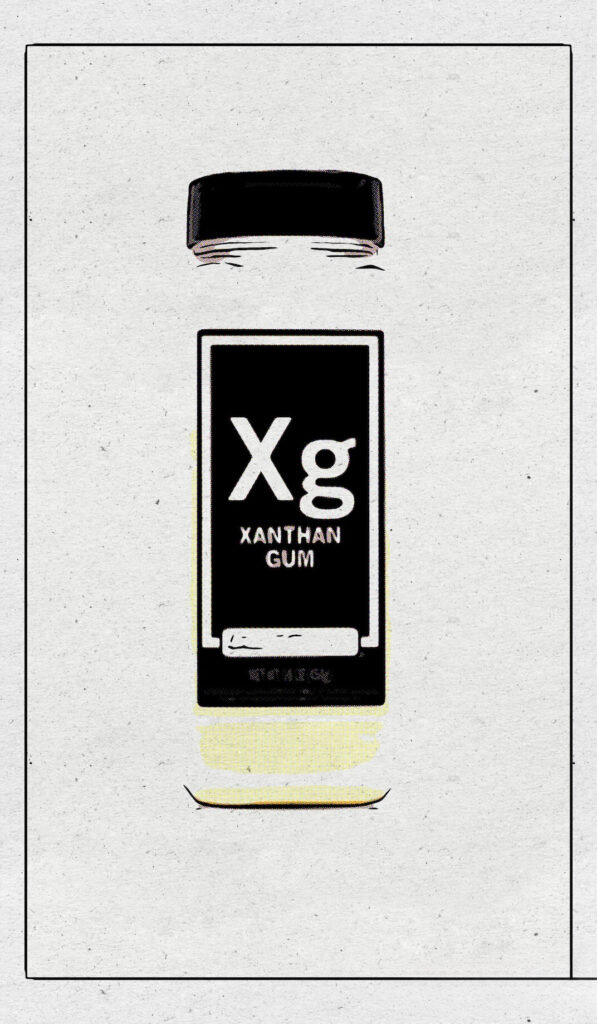 Xanthan gum is a safe and widely used food additive that stands in for the glue-like qualities of gluten. You have probably seen it on the labels of ice cream, salad dressing, gravies and even toothpaste.
It is a natural soluble fiber produced by fermenting a microorganism (Xanthomonas campestris, in case you need to know) with sugar, derived from corn, soy, dairy or wheat. After processing, no residue or protein from the growing medium remains, though those with severe allergies may still want to check which was used.
In baking, xanthan gum provides the structure that holds carbon dioxide bubbles inside your dough as it cooks. That is what stops gluten-free bread from collapsing the moment it leaves the oven. It also acts as a prebiotic soluble fiber that feeds beneficial gut bacteria.
It is pricey, but happily we only need a pinch. Xanthan gum typically makes up just 0.05 to 0.35% of a dry mixture.

Guar Gum
Guar gum is a powder made from the seeds of guar beans, a legume. It binds well, but it turns bakes noticeably gummy if you use too much. It also has laxative properties, and some people find they are sensitive to it or feel unusually full after eating it. In my experience, guar works best in cakes.
Guar Gum vs Xanthan Gum: Which Should You Use?
Xantham Gum | Guar Gum | |
Source | Fermented sugar (grown on corn, soy, dairy or wheat) | Ground guar bean, a legume |
Best for | Most recipes, especially breads and anything that needs to hold its rise | Cakes and softer bakes |
Cost | More expensive | Less expensive |
Watch out for | Allergy-sensitive bakers may want to check the growing medium | Laxative effect; some people are sensitive to it |
Texture risk | Gummy if overused | Gummy if overused, and more prone to it |
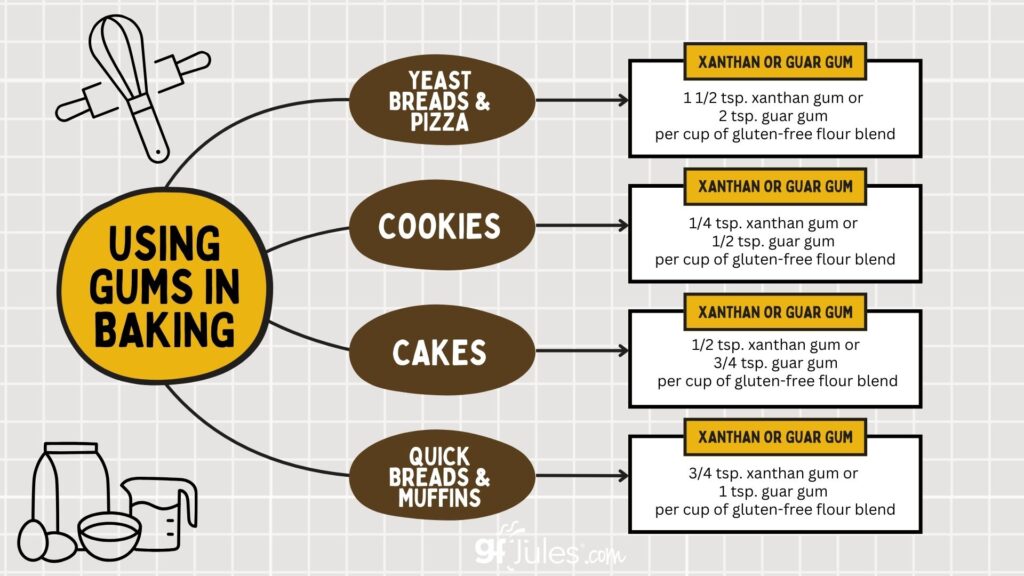
How Much Gum Do I Need?
If your all purpose gluten free flour does not already contain a gum, use the chart below as a guide.
If your flour already contains gums, they have been added in the appropriate amount. Do NOT add more. More is not better here, and too much gum will make your bake unpleasantly gummy.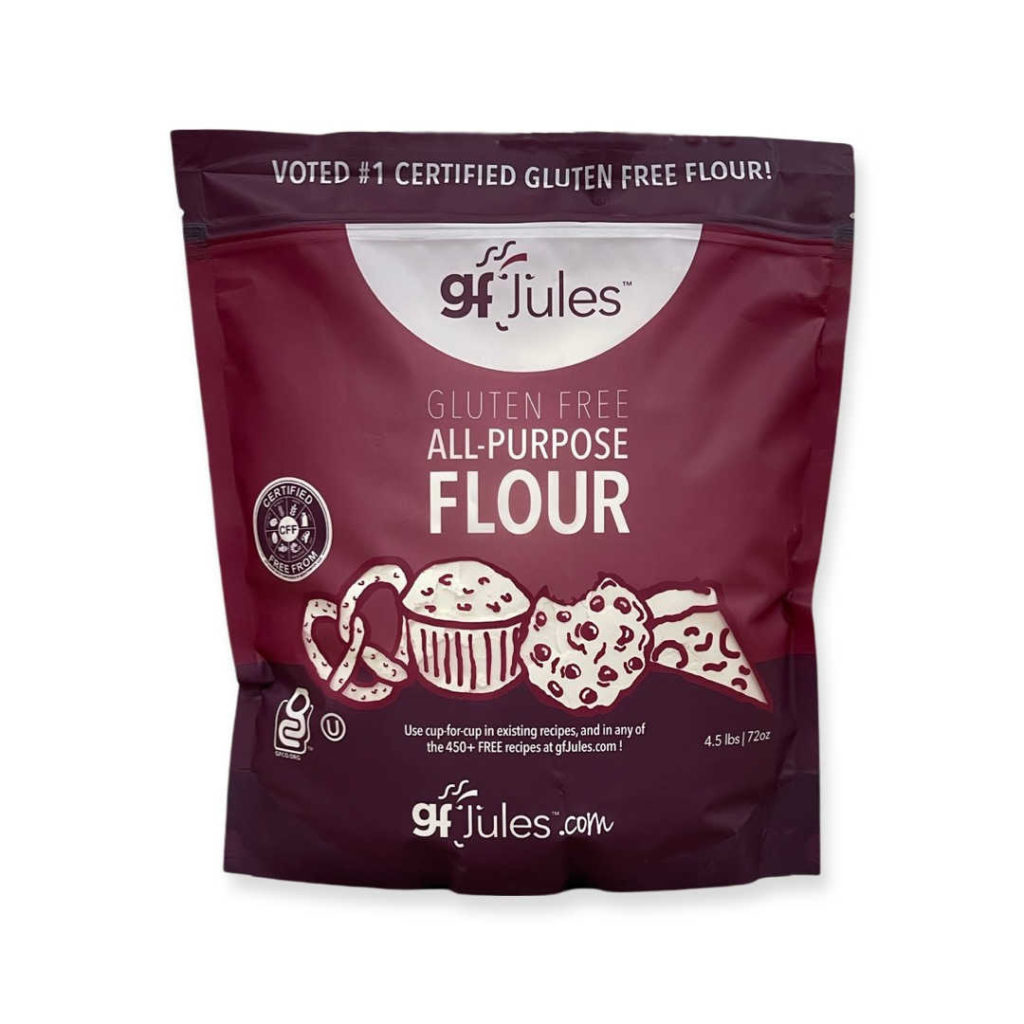 All gfJules products already contain the right amount of gums or husk.
Psyllium Husk Powder
Psyllium is a natural fiber derived from a shrub called Plantago ovata. The outer casings, or husks, of the seeds are ground into a powder which turns gelatinous when added to liquid, helping baked goods retain moisture.
Its ordinary use is as a colon cleanser, but in the small amounts used in baking it offers excellent binding without any tummy trouble. Those binding properties can replace gluten in gluten-free recipes, particularly breads, and psyllium can also replace eggs in vegan baking.
A few practical notes:
- Psyllium comes as whole husk or as powder, and the two are not equivalent. If a recipe calls for powder, use powder.
- If a recipe calls for xanthan gum, you can substitute up to 2 tablespoons of psyllium powder for every 1 teaspoon of xanthan gum, depending on the recipe.
- Psyllium works best in yeast applications like breads and pizza, and in homemade pasta.
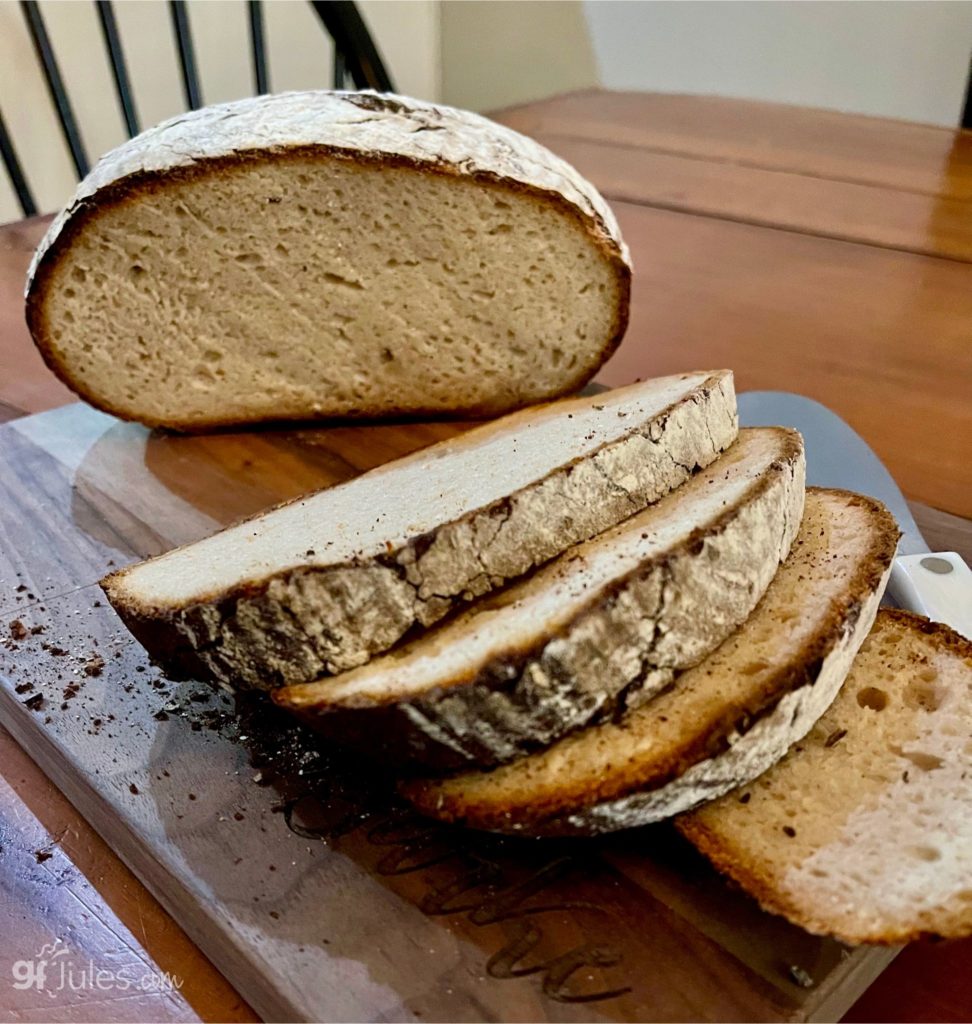
gfJules Gluten Free Bread Mix used to make Artisan Loaf. (gfJules Bread Mix contains psyllium husk)
Other Binders for Gluten Free Baking
Gelatin
You have probably used Knox unflavored gelatin before. It has excellent binding properties and works well as a gluten replacement in certain applications. Use the amount called for in your recipe and add it in with the dry ingredients. Do not use Jell-O for baking; use one specified for baking.
Gelatin is not vegan or vegetarian, as it is made from animal bones, hooves, and connective tissue. Some products labeled “gelatin” are marketed as vegetarian or kosher, which brings us to pectin.
Pectin
The vegetarian substitute for gelatin. Pectin is derived from the peels of apples, plums, cranberries, and citrus fruits. Like gelatin, it tenderizes breads and adds stability to baked goods. Add the powder in with your dry ingredients.
Agar Agar
Another vegan alternative to gelatin. Agar agar is a flavorless combination of dried algae that substitutes in equal amounts wherever a recipe calls for gelatin. It thickens, gels, stabilizes, and adds texture to baked goods, sauces, dressings, and drinks.
It comes as powder, flakes, sheets and bars:
- 1 bar = 4 tablespoons of flakes = 2 tablespoons of powder
- 1 tablespoon of flakes OR 1 teaspoon of powder thickens 1 cup of liquid
- For baking, add 1 teaspoon to every 1 to 2 cups of dry ingredients
Konjac Powder
Konjac powder, also sold as glucomannan powder, is made from the konjac root grown across Asia. It has remarkable thickening and water absorption properties, but it must be added slowly to liquids or mixed in with the dry ingredients, or it will clump.
Other Binders Worth Knowing
A handful of other ingredients can contribute binding and structure, and you may already have some in your pantry:
- Golden flaxseed meal and ground chia seed. Both form a gel when mixed with water and add fiber along with structure. Flaxseed meal is one of the ingredients in my Multigrain Biscuit & Breakfast Baking Flour for exactly this reason.
- Modified tapioca starch. Adds stretch and chew, which is why it appears in several of my blends.
- Mung bean flour and pre-gelled potato flour. Both bring binding properties, though they are more specialist and will affect flavor.
If you would like to go further into which flours do what and why blends matter, see my gluten free flour comparison.














Something you did not mention is that these various hrdrocolloid gums, used individually, are primarily thickeners. Certainly, gluten can be used as a thickener also. But, a single gum added in larger quantities doesn’t become the gluey doughy consistency of a lot of gluten. What you want in a dough ball is a stretchy consistency…and you can get that with various combinations of gums used together…xanthan & guar, locust bean & K-carrageenan, K & I carrageenans, xanthan & glucomannan, etc. Not all combos have this “1+1=3” gelling boost. For example, guar and agar. But, agar & pectin works. It takes some trial & error and, often, the stretchiest gel is obtained with other than 50-50 ratios of the 2 gels. But, you will find that the total amount of the 2 gels needed for a certain result will be less than what would be needed if using either one separately.
psyllium husk Usually used in baking items.
Question; Does your flour have xanthan gum already in the mixture? I’d greatly appreciate a quick response! I’m going to visit my gluten-free granddaughter and want to bake with her this coming weekend.
Thank you so much!
Trish
Hi Trish, yes! My gfJules Flour contains xanthan gum and you never need to add any to recipes. In fact, please don’t! Here’s a link to my gfJules Flour where you can read all about the flour, the ingredients and information on how to use it as the 1:1 flour it is in all your recipes. I hope you have a wonderful visit with your granddaughter! In the future if you have a time sensitive question, you can always email Support@gfJules.com or use the phone icon at the top of ever page to reach us!
~jules
recipes call for potato flakes. I can not find potato flakes, only instant mashed potatoes. Is this the same think and OK to use?
Hi, Nanchy, yes potato flakes and instant mashed potatoes (plain!) are the same. You should be good to go if you can find those!
~jules
Hi and thank you for the article. Can oat fiber, alone or in combination with flax seed meal, be used in gluten free sourdough breads without the addition of any of the binders you listed here? Thank you!
Hi Mila, great question but I’m afraid I don’t have the answer for you since I haven’t tried it myself. I don’t want to steer you wrong. It’s worth a try, but I don’t want to promise there won’t be other modifications that would also need to be made if you’re subbing for all the other binders entirely. The psyllium husk fiber, in particular, is key to helping the structure in this bread made without gluten, and the oat fiber will help, but I’m not sure it will do it all on its own. Please let me know if you do try it and how it works out so that others can learn from your experimenting as well!
Happy bread baking!
~jules
This would be much more helpful if substitution ratios were given!
Hi julies 😊. Thanks for the information. Quick question : You said that If a recipe calls for 1 teaspoon of xanthan gum we should use up to 2 to 3 tablespoons of psyllium powder. But what is the recipe calls for 1 tsp Of guar gum ? Thanks In advance