

For those who love sourdough, making your own gluten free sourdough starter will become a ritual that gives back in spades. This homemade gluten free sourdough starter recipe is easy and useful for so many recipes, not just gluten free sourdough bread!
In the several years I’ve been making gluten free sourdough starters, I’ve learned some things that have helped to ensure success. Please read through the notes below so you don’t miss the tips that will help you make a great gluten free starter!
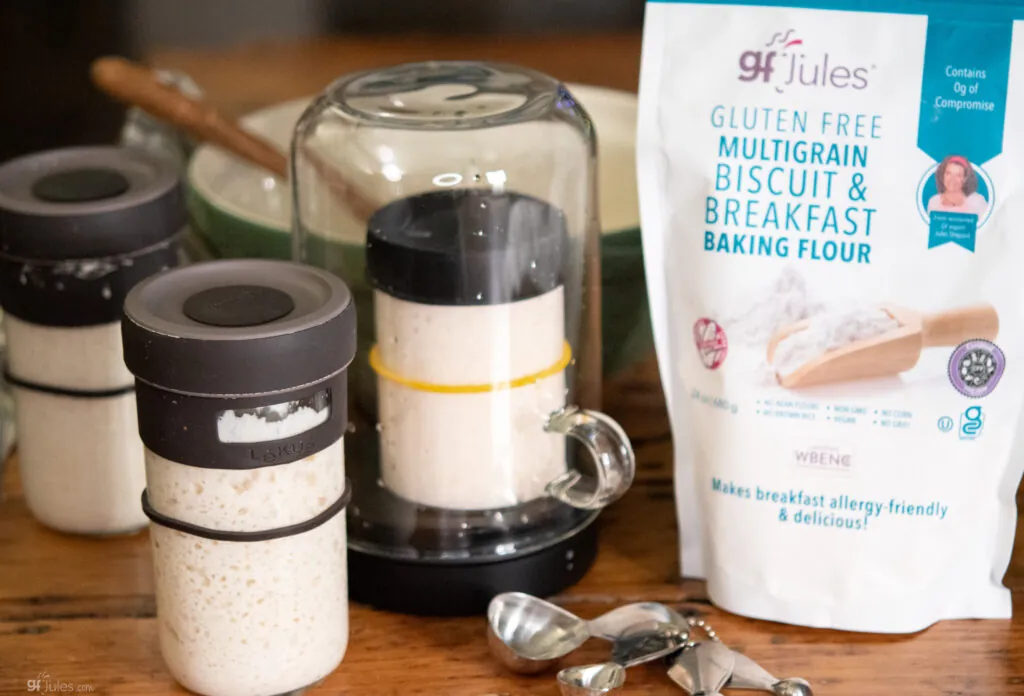
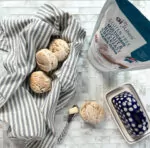
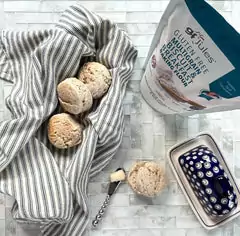
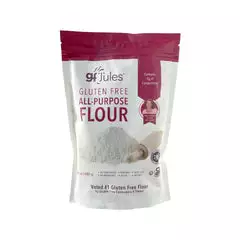
I highly recommend my gfJules Gluten Free Corn-Free Multigrain Biscuit and Breakfast Baking Flour as the base for making your gluten free sourdough starter.
My gluten free starters love this blend, and it makes great bread, too!
How Do I Make Gluten Free Sourdough Starter?
Sourdough starters of any kind can be made with yeast or with yogurt with active cultures. If using yeast, be sure to use yeast that is gluten free — luckily most dry yeast is gluten free.

The one note able exception is Platinum Sourdough Yeast out from Red Star which is made with both rye and wheat and therefore is NOT gluten-free. DO NOT USE THIS YEAST to create your gluten-free starter or any gluten free breads.
Aside from yeast or yogurt, you’ll also need gluten-free flour whole grain flours to feed the starter. As mentioned, my gfJules Gluten Free Multigrain Biscuit and Breakfast Baking Flour is my favorite choice for making a gluten free starter. This one blend makes it easy to feed and make gluten-free sourdough easy.
You’ll also need a non-reactive container to store your starter in: glass, glazed pottery, stainless steel, or food-grade plastic will work. Make sure the container is large enough to hold your starter for the duration — it will grow!
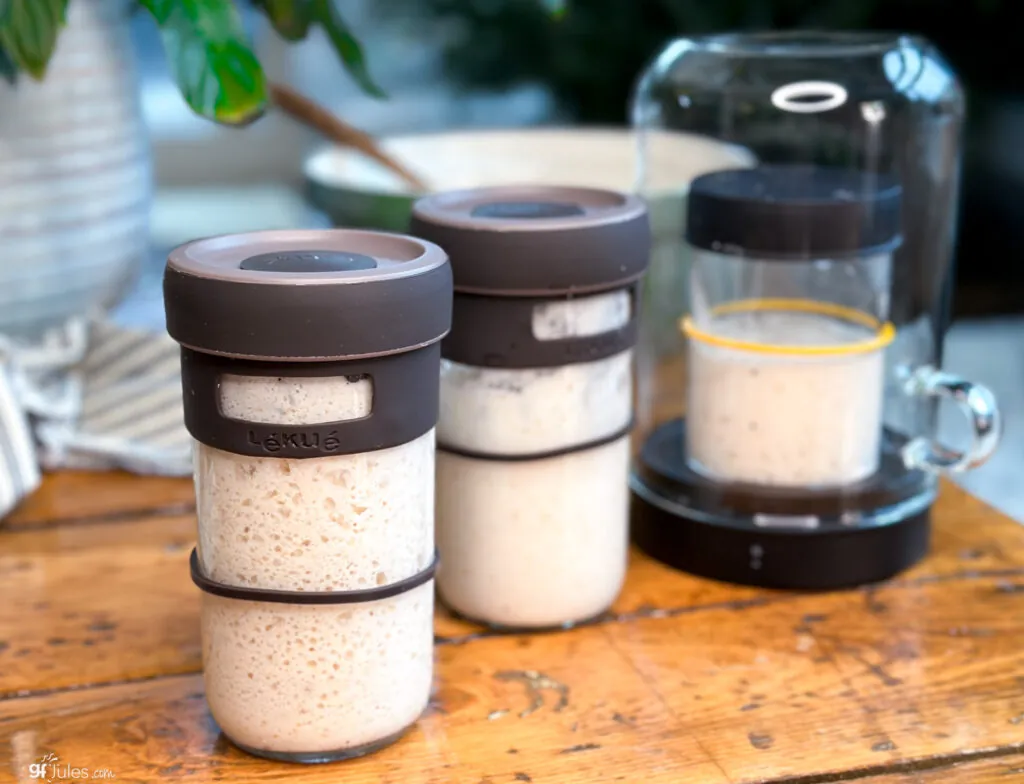
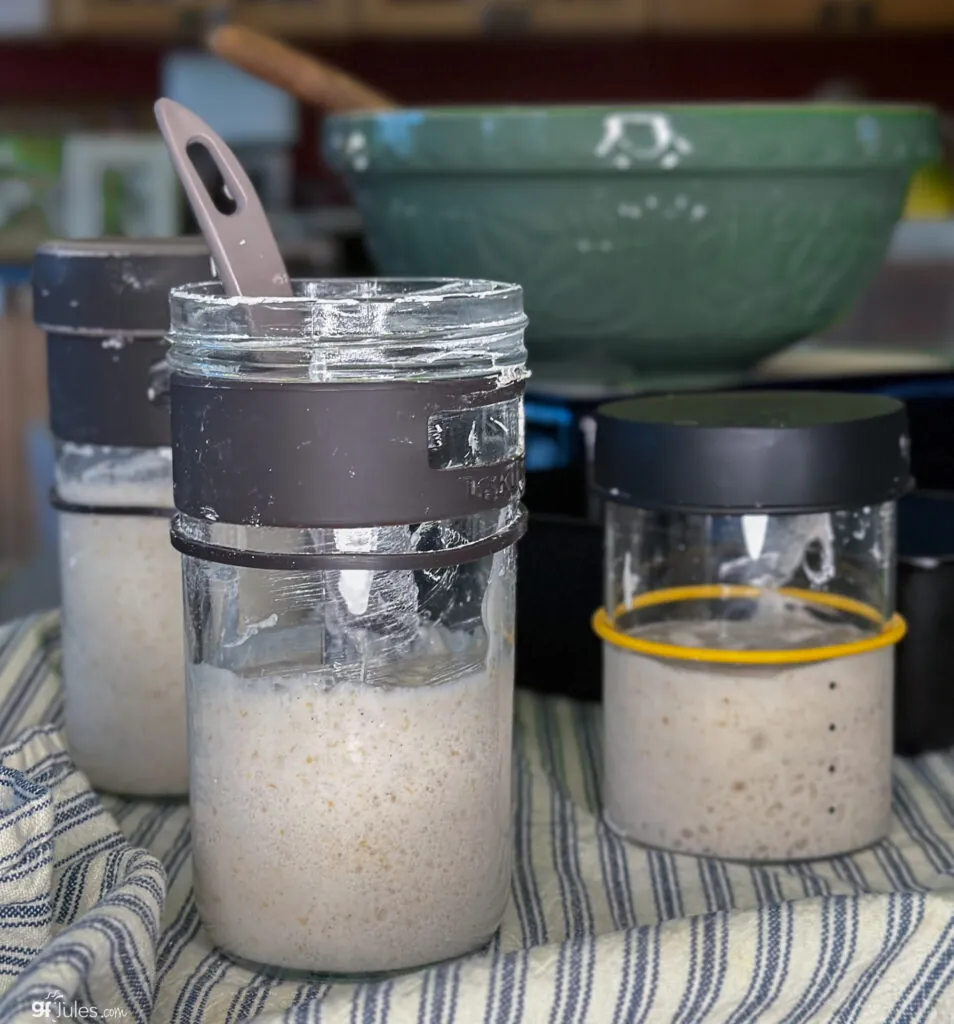
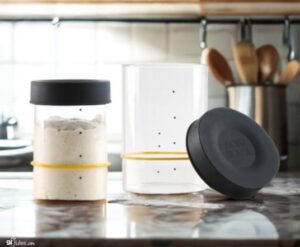
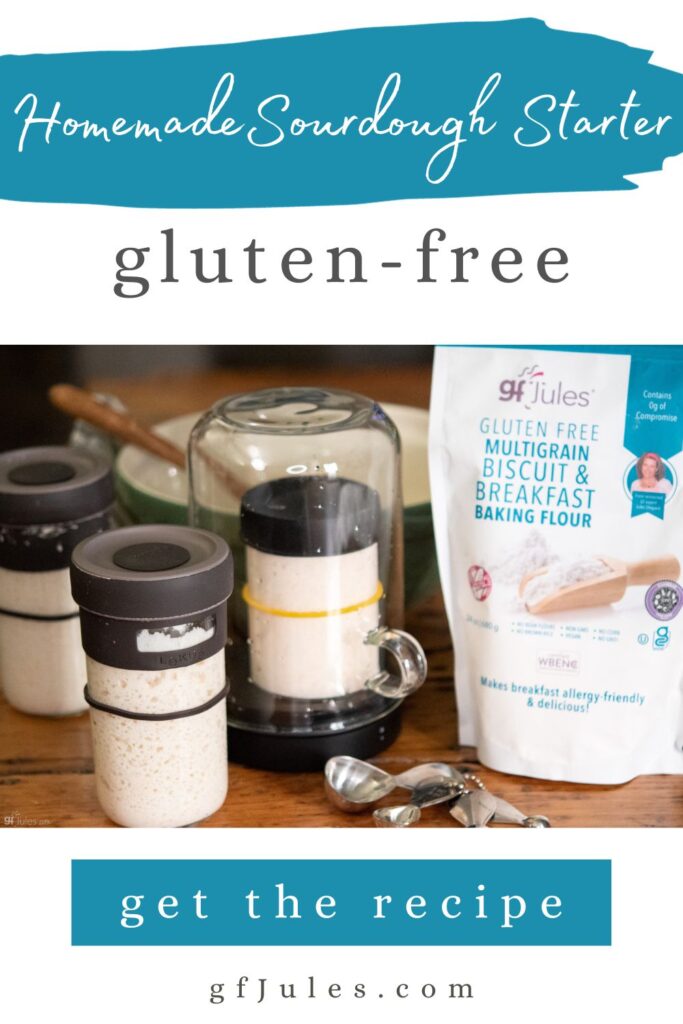
I really like these lidded jars from Lekue with CO2 outlets to let the gasses out without letting gnats and other unsavories in. Sourhouse also makes pint and quart glass jars that I also really like. You’ll see it pictured with many of my gluten free starters.
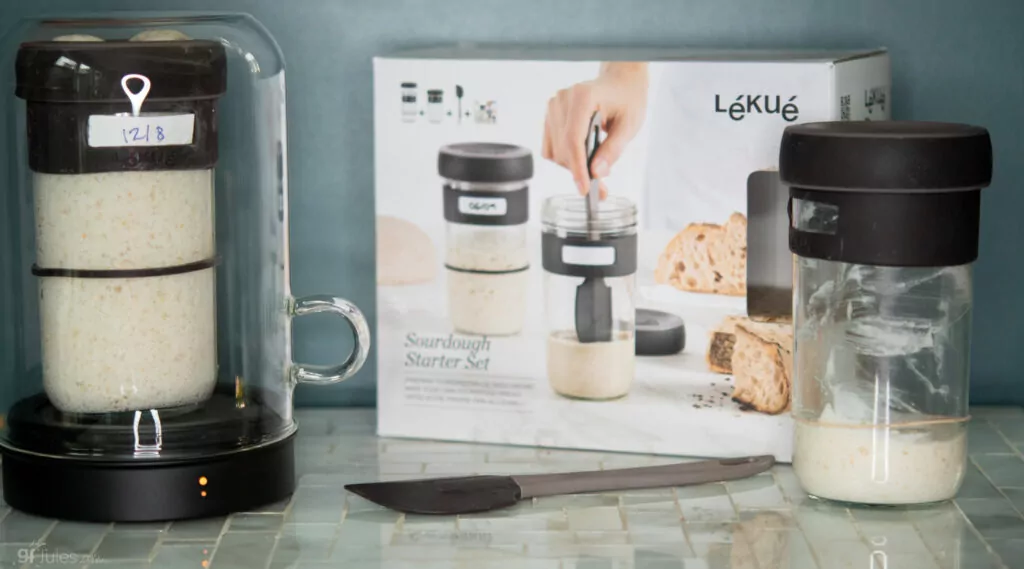
I also like the Goldie Sourdough warmer Sourhouse for keeping the temperature consistent for optimum sourdough growth.
None of these is required, however.
If you use a simple bowl to grow your starter instead, you’ll also want to have some cheesecloth or muslin to cover your starter for the first week or two when it’s on the counter. The porous material will allow yeast in the air to settle on the starter and help to “feed” it.
Gluten Free Sourdough Starter Recipe Tips
(Note: the below recipe has been modified to reflect the notes from other readers over the past few years who have added their recipe tips from their own experimentation. Many thanks to all who have taken the time to contribute!)
Please read through all the steps below before emailing me with questions. I have made every attempt to address most issues for you, and your fellow gluten free bakers have also addressed many questions in the comments — mostly found on my gluten free sourdough bread post.
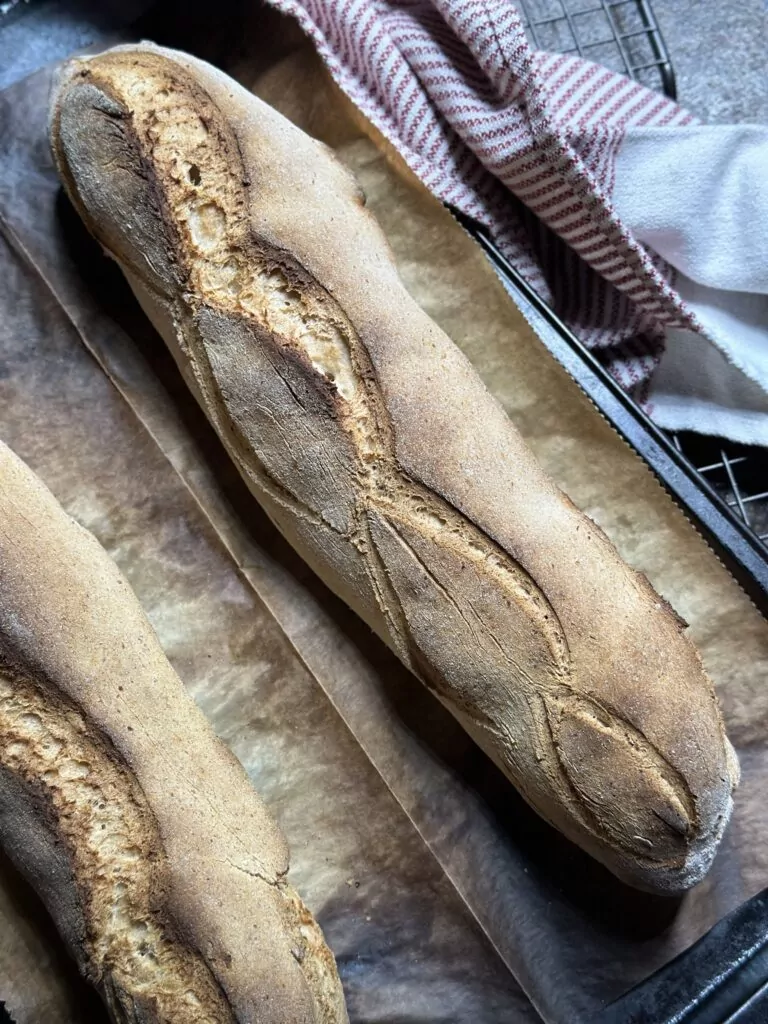
How Do I Use Gluten Free Sourdough Discard?
As I mentioned earlier, I found it hard to part with any starter by tossing it down the drain, but traditional methods say to feed the starter and then discard all but 1/4-1/2 cup of starter; many times, I divided it into another container and gifted the starters to ambitious gluten free friends.
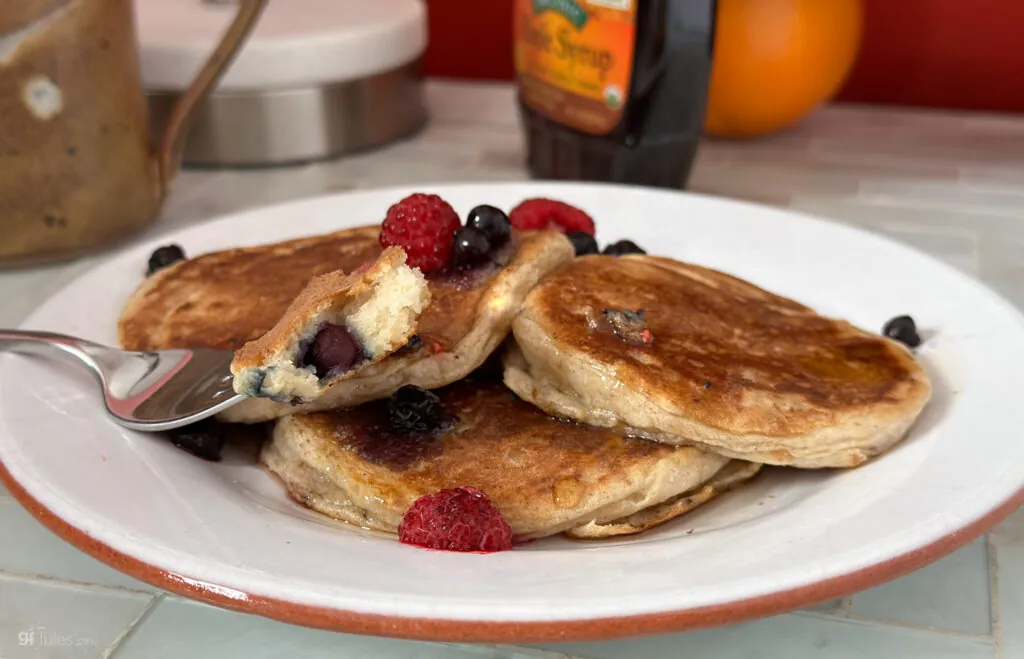
Gluten Free Recipes Using Sourdough Discard
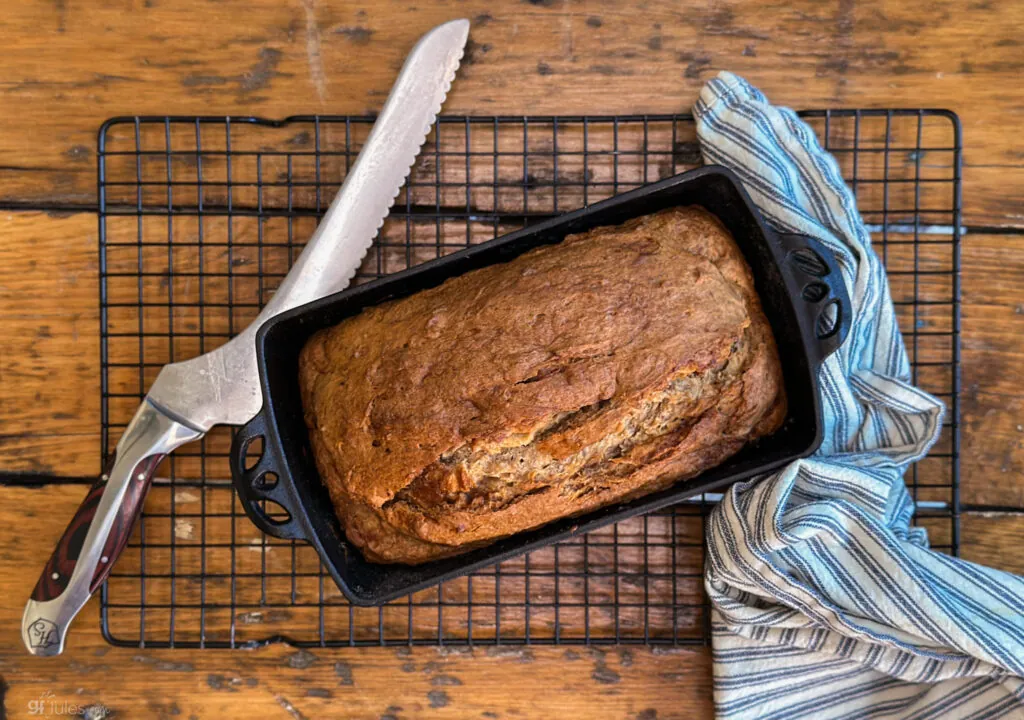
Luckily I’ve developed a lot of gluten-free recipes using that precious gluten-free sourdough starter discard! Recipes like gluten free sourdough pizza, gluten-free sourdough breadsticks, gluten free sourdough scones, gluten-free sourdough banana bread, gluten-free sourdough pancakes, even gluten-free sourdough granola …. Just use your gluten free starter in place of yogurt or sour cream or even milk in many recipes or replace 1/4 cup of gluten free flour in most recipes with 1/2 cup of gluten free starter.
What Should Gluten Free Starter Look Like?
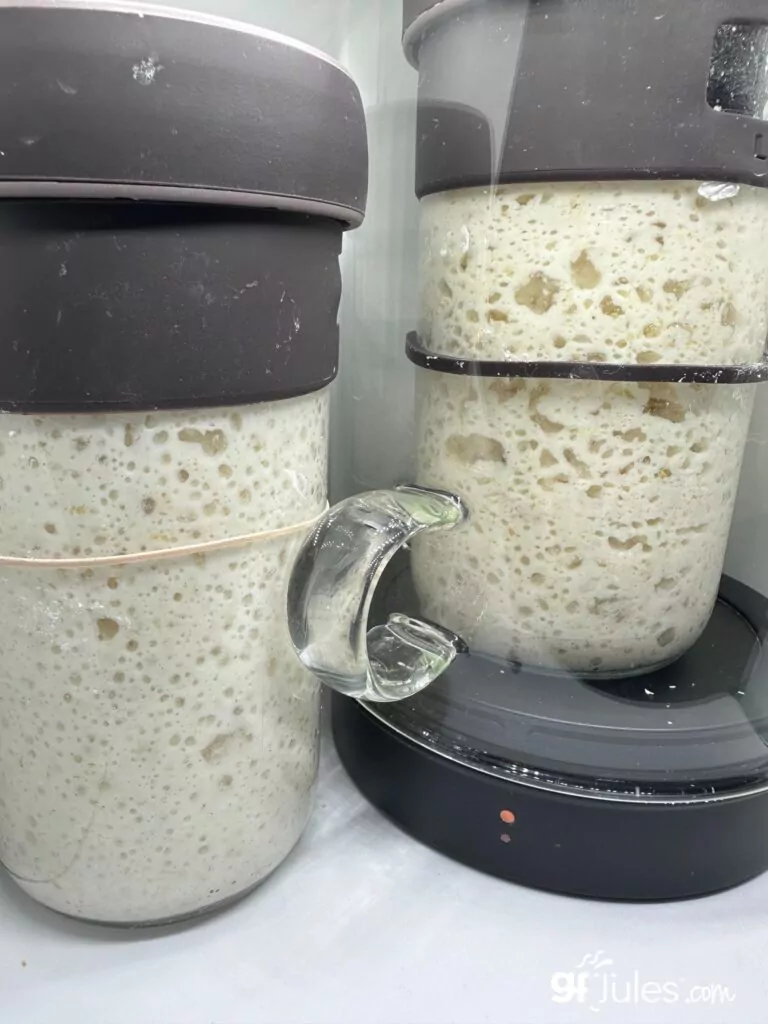
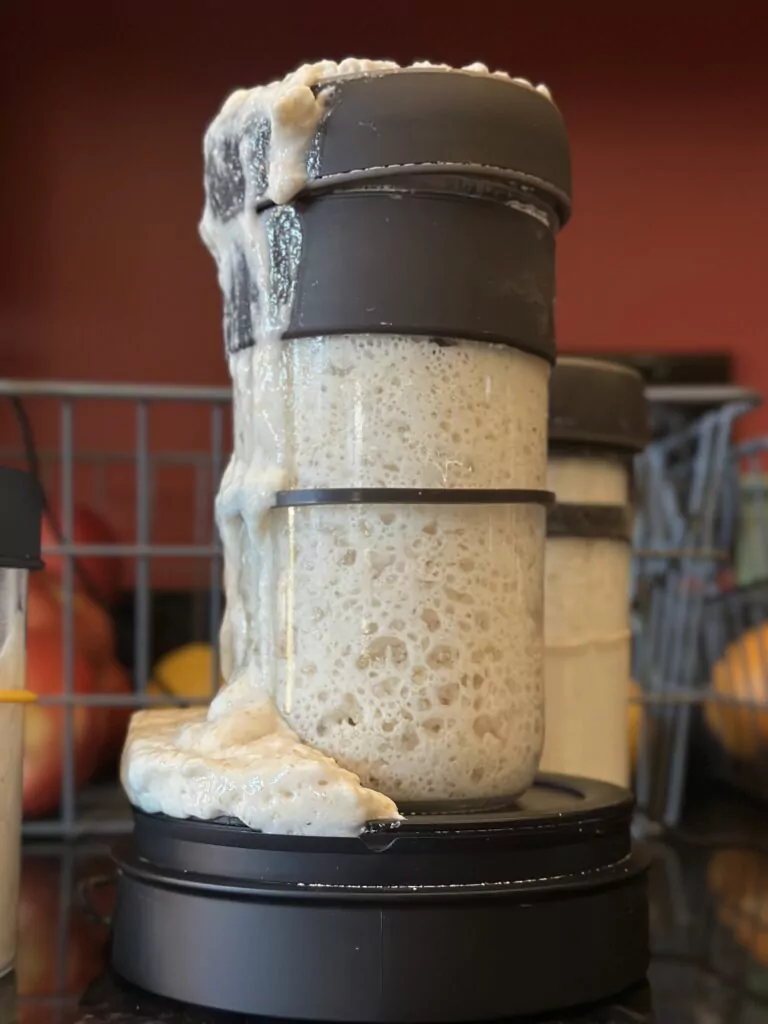
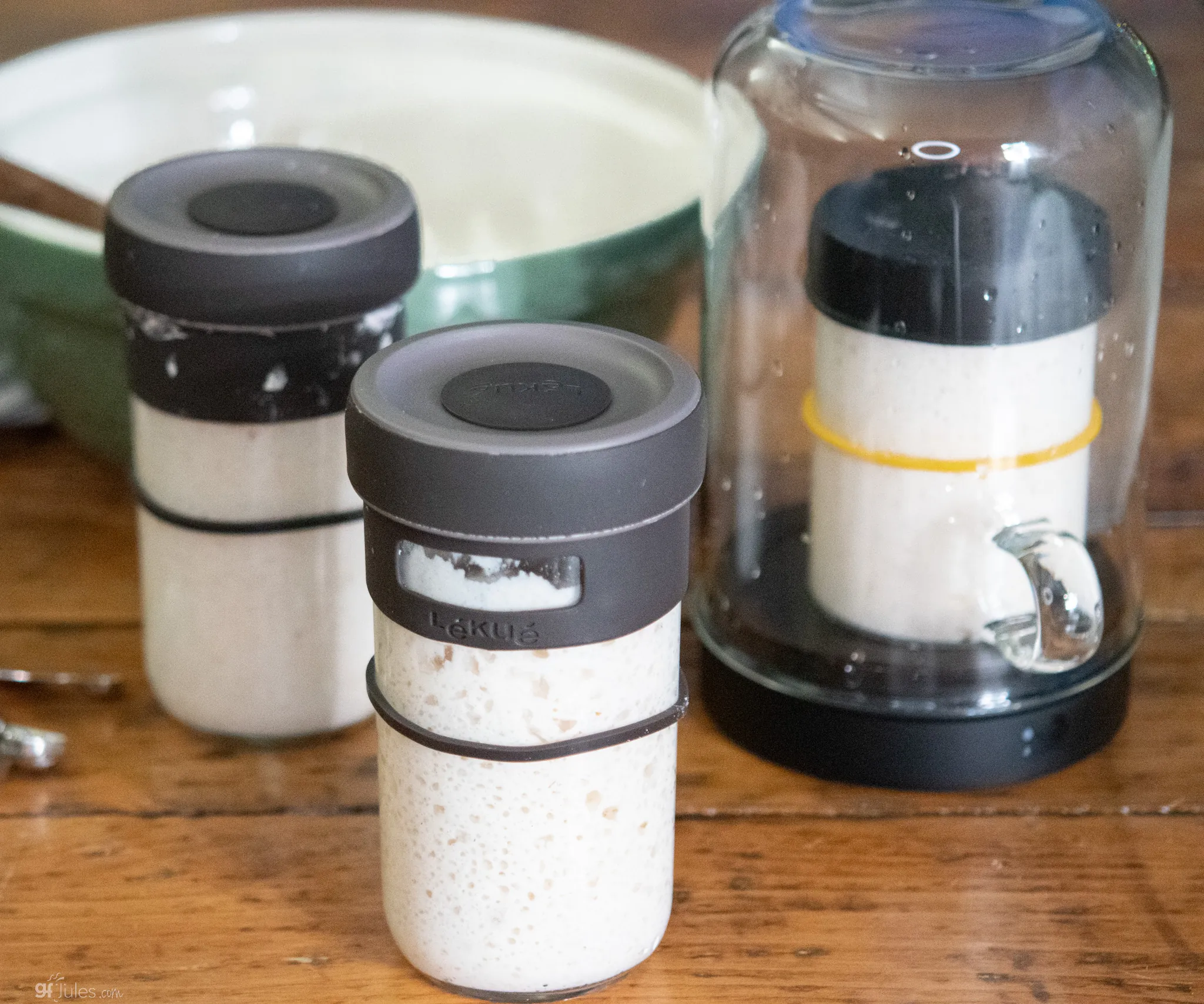
Wondering what does active gluten free sourdough starter look like? The photo just below shows what active gluten free sourdough starter should look like: it has open air pockets and is light and fluffy.
The jar on the right is even more open and airy because it’s been growing in the Sourhouse Goldie warmer; the one on the left is at room temperature in a chillier kitchen, but both are “active” starters.
Every time you use the starter for baking, pull it out the night before or at least a few hours before to allow it to come to room temperature and feed it again. Ideally it would be fed and sit for 12 hours before using, but it’s not required to wait that long once you have an active starter. After you’ve added the starter to your recipe, feed the remaining starter again and return to the refrigerator.
Here’s an example of how to use an active starter once you get going in your gluten-free sourdough routine:
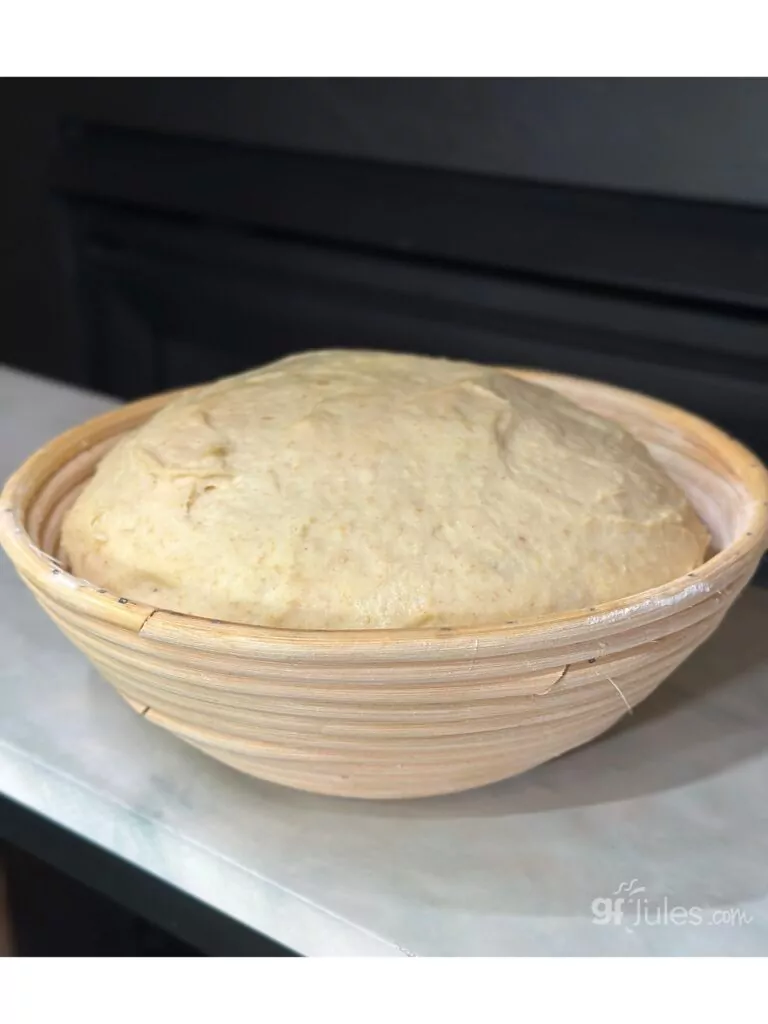
This weekend, I made a couple gluten-free sourdough loaves by taking my starter out of the fridge each day, feeding it at 8 am, then by 12 or 1 it was ready to use in my loaves. I mixed up the dough, fed the starter and returned it to the fridge, set the bread dough out to rise in a warm spot for about 4 hours, then baked it. The sourdough was ready as fresh bread for dinner!
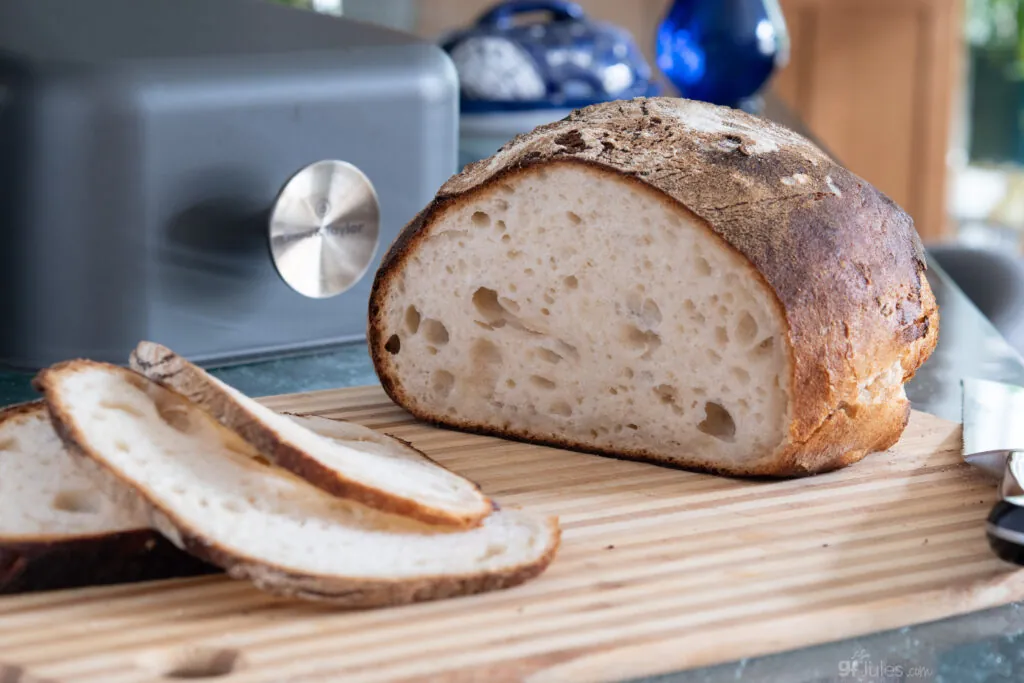
Note that in a pinch you may use your gluten free sourdough starter right from the refrigerator, whether you’ve fed it again or not.
If you have recently fed it, it will be more active, but even if not, it should still rise your dough with enough time. Allowing it to come to room temperature first will bring faster fermentation though.
How Do I Store Gluten-Free Sourdough Starter If I Don’t Use It Every Day?
Once you have your gluten free starter live and happy, you may not want to use it every day. After it’s mature, you should be able to keep it in the refrigerator indefinitely, but it should be a well-established starter before you relegate it to the fridge.
I’ve found that by putting a layer of gluten free flour on top of the starter in a glass jar, then covering it with a lid but giving it extra room in the container to breathe, is a good way to store it in the refrigerator if you’re going to be skipping feedings. You can then bring the starter out of the refrigerator the day before you want to bake with it and start the feeding process again to wake it up. It’s a great way of keeping your starter alive, but not having to feed it weekly after it’s active.
Depending on how long you’ve stored it in the refrigerator, it may take more feedings to revive your starter, but you’ll know when it’s happy and active again based upon the bubbles created and the volume of the starter after feedings.
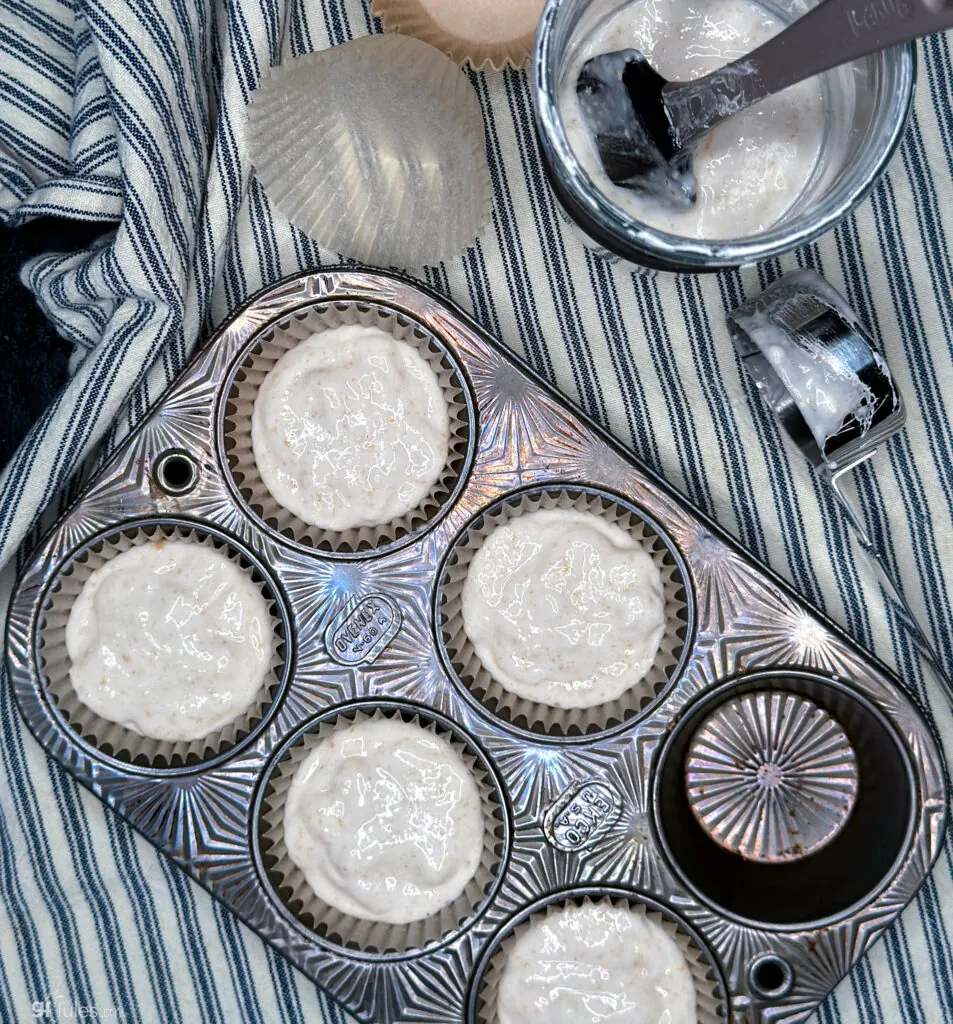
You can even freeze gluten free sourdough starter for using later.
I like to portion the starter into muffin cups in 1/4 cup servings for easy measuring later. Freeze the tray and once hard frozen, place individual cups into a freezer bag and remove one or more the day before you want to use it; place in a jar in the fridge.
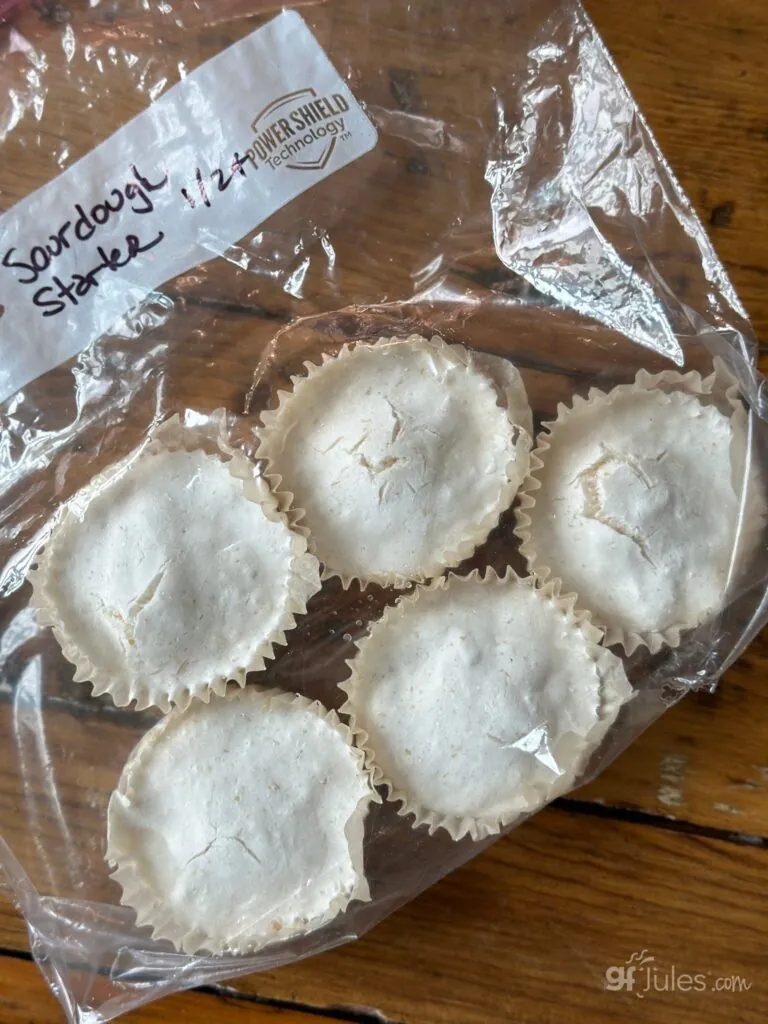
Once thawed, begin the feeding process again until it shows signs of liveliness.
How Do I Reactivate Gluten-Free Sourdough Starter?
The number one issue is that folks feel like their gluten-free sourdough starter isn’t active enough and they feel they must throw it out. Please DON’T! Unless your starter has pink mold on top, any smells are likely the good “sour” smells you’re trying to develop. Mold is not something you’re striving for in your starter though, and if that gross pink mold develops, throw out the starter and begin again. Using filtered water helps prevent mold.
I’ve been out of town for extended periods of time and come home to find that there is some blue mold around the edges of my sourdough. Not my favorite fridge discovery, but I’ve simply scraped the top half of the starter out as discard down the drain and fed the rest of the starter. It was totally fine. My current gluten-free starter has been going for over a year now and is still producing lovely loaves, so I’m glad I didn’t simply toss the entire starter!
If you find your gluten free starter is not active, here are the best tips for re-activating your gluten free sourdough starter:
- Add another 1 Tablespoon apple cider vinegar.
- Add 1 teaspoon more yeast or yogurt.
- Add 1 tablespoon honey or agave, maple syrup, date syrup or coconut nectar.
- Alternate adding a different whole grain gluten free flour like quinoa, teff, buckwheat, millet, sorghum, brown rice. The protein and wild yeasts more likely to be present in these flours may help to re-energize the starter.
- Be sure you’re discarding half of the starter with each feeding to give the remaining starter enough food, proportionately, when you’re feeding with more gluten free flour.
- Make sure your starter isn’t too thick — it should be the consistency of pancake batter, not dough. Add more filtered water if needed.
Key Tips for using Your Gluten Free Sourdough Starter:
- For best rise, feed your gluten-free sourdough starter 4-12 hours again before using it and bring to to room temperature (if stored in the refrigerator)
- You may still use the starter stored in the refrigerator that wasn’t just fed; your loaf will have less springiness and will take a lot longer to proof.
- Using starter that is not fed a few hours before will produce a loaf with more sour flavor.
- Unfed starter can still rise the sourdough, even after two weeks in the fridge. Bring to room temperature before using, if possible.
- Use your sourdough discard in other recipes like quick breads and pancakes. The general rule of thumb is 1/2 cup of starter = 1/4 cup flour, so if you remove 1/4 cup gluten free flour from your recipe and replace with 1/2 cup of gluten free starter, you should be able to convert most recipes with very little adjustment.
Gluten Free Sourdough Starter Recipe
Gluten Free Sourdough Starter Recipe
Ingredients
- 1/2 (70) cup (grams) gluten free flour -- gfJules Corn-Free Multigrain Biscuit & Breakfast Baking Flour recommended OR use 1/4 cup gfJules Flour PLUS 1/4 cup ONE of: sorghum flour; buckwheat flour; teff flour; quinoa flour; millet flour; or brown rice flour
- 1/2 cup filtered water - room temperature
- 1/2 Tablespoon apple cider vinegar (with "the mother" - shake the bottle)
- 1/2 teaspoon gluten free dry yeast* OR 1 Tablespoon yogurt (dairy-free works fine)
Instructions
- Whisk starter ingredients in bowl or glass made of glass, stainless steel or food-grade plastic.
- Set aside for 24 hours in a warm place with a loose cloth covering the top.
- FEEDING: Discard half of the starter. To the remainder of the starter stir in 1/2 cup (70 grams) gfJules Multigrain Flour + 1/2 cup filtered water.
- Re-cover and rest for 24 hours.
- At this point, the starter should show signs of activity, but if not, don't despair, and don't throw it out! Repeat the FEEDING step every 12 hours until the starter begins to bubble (becomes active).
- Continue FEEDING step once a day for 7 days (best) OR until the starter doubles in volume and looks very bubbly within 6 hours after feeding. At that point, feed one more time, then allow to rest for 6 -12 hours before using.
- To store in the refrigerator, transfer to a lidded jar but DO NOT tighten lid completely. Feed starter once a week.

Video
Notes
** Please keep in mind that nutrition information provided is per serving, which may vary. While we have taken care to provide you with the most accurate nutritional values possible, please note that this information may differ significantly depending on the exact ingredients and brands that you choose to use to make this recipe. Additionally, where options are given for ingredients, the resulting calculation may include all ingredient options instead of only one per line, skewing the totals significantly.
Recommended Products
Any links to Amazon may earn me a small amount from qualifying affiliate purchases; this amount goes to fund this blog and does not cost you anything additional.
Now that you have your active starter, you’re ready to bake your gluten free sourdough bread!
To make your favorite gluten free sourdough bread recipes, hop to my gluten free sourdough bread recipe post!
Pin for later!
*In some cases, sponsors have provided free product. Some links to products may be affiliate links. As always, all opinions are my own. See my disclosure policy for more information. Working with select brands I love allows me to keep bringing you free recipes and great contests! I hope that in the process, you’ll learn about some of the safe gluten free products I choose for my family. Thanks so much for your support!











Do you have a book or recipes for adding additions (cheese, honey, etc.) to your sour dough recipes?
Hi Lauren, a couple general rules of thumb for adding cheeses to bread doughs like sourdough would be to select harder, low-moisture cheeses like sharp cheddar, Asiago, or Parmesan, and add about 5-6 ounces per loaf. For dried herbs, use about 1/2 – 3/4 cup finely chopped herbs per loaf. For either one, don’t add more than about 15% of the total weight of the flours in the recipe. Add by flattening the dough out on the bench and spreading the cheese or herbs across the dough, then rolling up for a swirl or simply gathering the dough together to form the shape of loaf you are baking. I hope that helps!
~jules
Thank you much for this recipe. I am excited to try it.
In Step 3 – (or 1/4 cup gfJules All Purpose Flour plus 1/4 cup alternate GF flour listed above) – can we use 1/2 cups of the AP Flour if we don’t have one of the “other” flours (buckwheat, millet, etc)?
Hi Faith, you can absolutely just use 1/2 cup of the gfJules All Purpose Flour instead, but if you notice any lag in starter activity, you’ll want to add either the gfJules Multigrain or one of the other flours. gfJules All Purpose is a refined blend and doesn’t have a lot of whole grain or wild yeast in it like the other options would, so the starter activity can be reduced by using just that flour alone.
~jules
Hello! I started the starter last week and I’ve had no bubbling. I used all of your tips and it’s still not bubbling. Should I just dump it out and start over?
Hi Stephanie, what flours have you been using? Has it not bubbled at all?
~jules
Would it work to use your gluten-free bread flour for the sourdough starter? That’s what I have.
Hi Beth, you can absolutely do that. If you find that it is not working as well as you’d hoped though, I would recommend switching it up though. The baking powder/soda in the bread mix may dampen the activity somewhat.
~jules
I just started my sourdough starter and it has tripled in size within 6hrs. Is my starter active to use or do I still need to follow your first few steps of the above listed 2-4? Photos attached
Yes, you still need to follow the steps and wait at least 6 or 7 days. This matures the starter and also lends the sour taste, although with gluten free starters, the sour taste isn’t as noticeable until the starter is older or you allow the bread to rise overnight. But you’re off to a great start!!
~jules
Hi Jules – what is the science/reasoning behind leaving a layer of flour on the starter when not using it for an extended period? GF is different – I don’t see a wheat flour analog for this.
And, how much do you put on top? And, when you bring it back out, what do you do with that flour?
I’m maintaining a 100% hydration in two different GF starters and need to go away for a while. I need to account for that flour – either by removing it, adding equal water when I stir it in, etc.
Hi Ann, you can skip that step if you like and feel more confident about your ratios without adding a layer. I have tried it both ways and it doesn’t seem to make much of a difference either way, but when I’ve added the layer of gf flour, it’s been enough of a layer just to cover the surface, not enough to created a marked difference in my proportions. I have read other gluten sourdough bakers who love this method for preserving their starters in the fridge for longer periods of time, but it’s not required. If you do add the layer, when you bring it out of the fridge, you simply stir it into the starter before executing the discard and feeding step. If you’re going away for awhile, you may want to experiment and put some in the freezer and see how that works out for you, as well. Options!
~jules
Any substitute option for Apple cider vinegar? I’m allergic to apples but I’d love to have sourdough bread.
Hi Carolyn, yes – you can use lemon juice or other vinegars instead. Don’t let that stop you!
~jules